Most Website Migrations Don’t Fail on Launch Day; They Fail Weeks Later—Quietly.
Traffic drops.
Conversions slip.
Ad spend continues, but results don’t.
Nothing looks obviously broken. And that’s exactly what makes it dangerous.
Most migration articles list the same risks:
SEO drops, broken links, downtime, and data loss.
You already know those can happen.
What they don’t tell you is:
- How severe each risk actually is
- How long recovery really takes
- Which problems don’t show up until weeks later
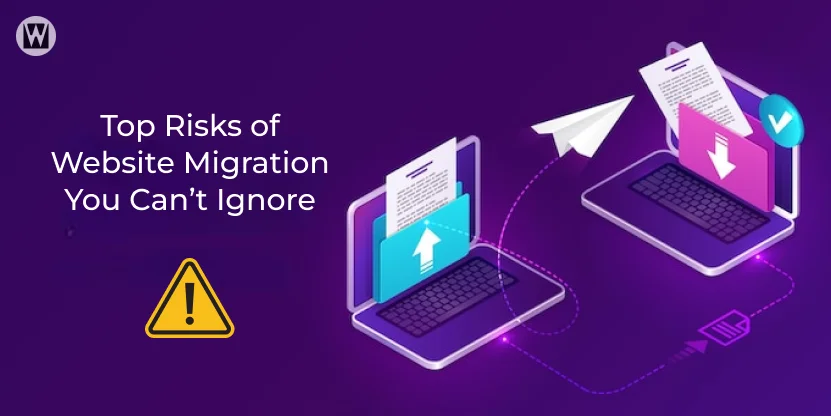
This article explains the real risks of website migration—including the ones most teams miss—so you can plan with clarity instead of assumptions.
Before diving into risks, it’s important to understand the different types of website migration, as each type carries a different level of SEO and technical risk.
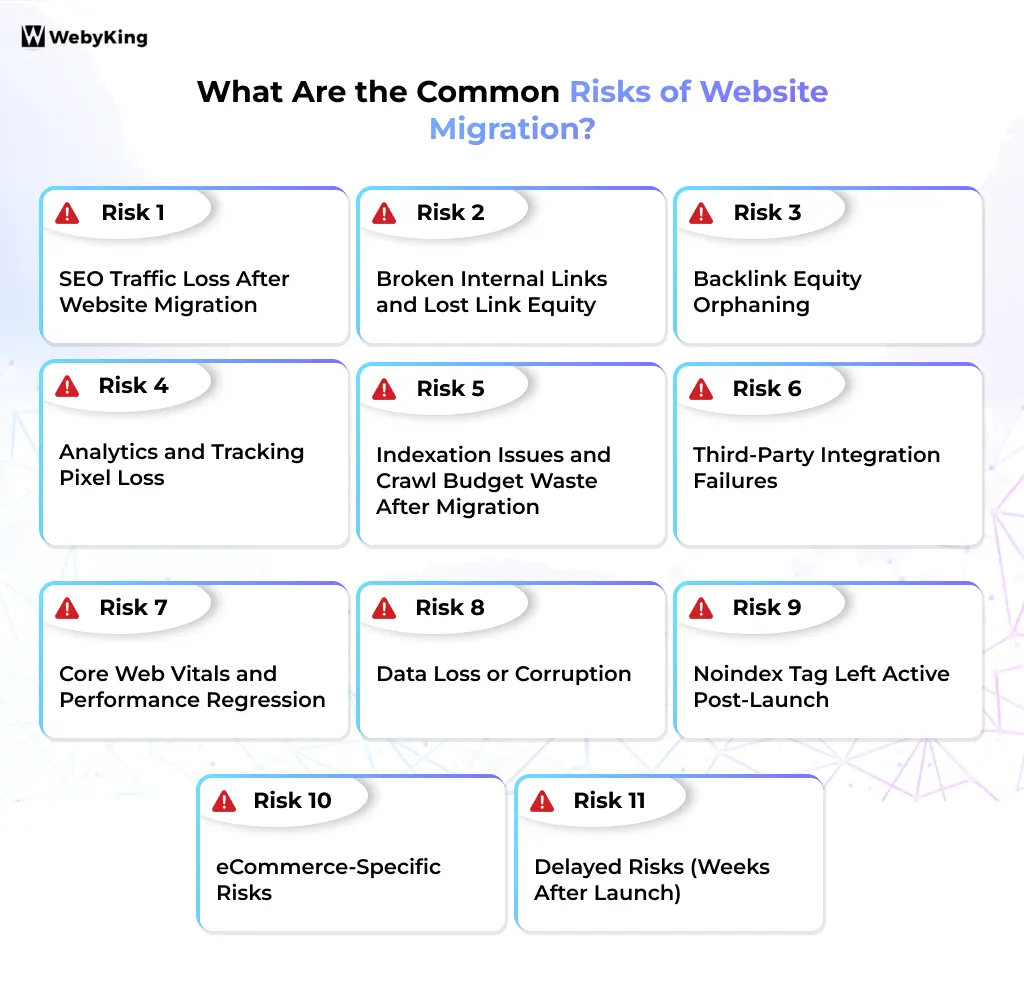
What Are the Common Risks of Website Migration?
Website migration risks include SEO traffic loss, broken redirects, backlink equity loss, tracking failures, data loss, indexing issues, and third-party integration breakdowns. These risks can be immediate or delayed and may significantly impact rankings, conversions, and revenue if not properly managed.
Website migration risks are the technical, SEO, and operational failures that can occur when a site changes its domain, structure, platform, design, or infrastructure.
The most common include:
- Organic traffic and ranking loss
- Broken redirects and internal links
- Backlink equity loss
- Analytics and tracking failures
- Data loss or corruption
- Performance and indexing issues
- Third-party integration breakdowns
Some are immediate.
Some are delayed.
Some are recoverable.
Some are not.
Each risk is evaluated across four dimensions:
- Severity — how badly it can impact your business
- Recovery time — how long it typically takes to stabilize
- Preventable? — whether it can be avoided or only minimized
- Most relevant to — which migration types are most affected
| Risk | Severity | Recovery Time | Permanent Risk |
|---|---|---|---|
| Traffic & Ranking Loss | High | 2–12 weeks | No |
| Broken Links | Medium–High | 1–4 weeks | No |
| Backlink Loss | Medium–High | Permanent | Yes |
| Tracking Failure | High | Immediate | Yes (data loss) |
| Indexation Issues | Medium | 4–12 weeks | No |
| Data Loss | Very High | Permanent | Yes |
Risk 1: SEO Traffic Loss After Website Migration
Severity: High
Recovery time: 2–8 weeks (with proper redirects), 3–6 months (if not)
Preventable? Partially
Most relevant to: Domain changes, URL restructuring, platform migrations, redesigns
What actually happens
When you change URLs, restructure architecture, or switch platforms, search engines have to:
- Recrawl your site
- Reprocess signals
- Re-evaluate rankings
During this window (typically 2–6 weeks), fluctuations are normal.
What’s not normal is when traffic doesn’t come back.
Example: A B2B website migration saw a 40% traffic drop that didn’t recover for 3 months—not because of algorithm changes, but because key category pages were missing proper redirects.
That usually means:
- Redirects are missing or incorrect
- 302s are used instead of 301s
- Metadata and SEO signals were lost in the migration
The business impact
An estimated 30% traffic drop on a site with:
- 10,000 monthly visitors
- 2% conversion rate
- $100 AOV
= $6,000/month in lost revenue
And that’s before factoring in time spent diagnosing the issue.
The risk most teams miss
JavaScript-based redirects
They appear to work—but often fail for search engines.
The result:
- URLs get deindexed
- Link equity doesn’t transfer
- Rankings collapse quietly
You don’t notice immediately. You notice when traffic is already gone.
Key takeaway
If redirects aren’t server-side 301s, they’re not reliable.
Risk 2: Broken Internal Links and Lost Link Equity
Severity: Medium–High
Recovery time: 1–4 weeks
Preventable? Yes
Most relevant to: URL restructuring, platform migrations
What actually happens
- Help search engines crawl your site
- Distribute authority
- Define content hierarchy
When URLs change
- Links become redirects—or break entirely
- Authority weakens
- Crawling becomes inefficient
The subtle failure most teams miss
Navigation, footer, and breadcrumb links.
These exist on every page.
If they point to old URLs, you’re creating site-wide inefficiency at scale.
Key takeaway
Risk 3: Backlink Equity Orphaning
Severity: Medium–High (often permanent)
Recovery time: Permanent if missed
Preventable? Yes
What actually happens
Backlinks are one of the strongest ranking signals.
If the destination URL changes and isn’t redirected:
- The link still exists
- But the value doesn’t
It’s ffectively lost.
Why this matters more than it seems
You don’t need to lose all backlinks.
Losing just your top-linked pages can significantly impact rankings for competitive keywords.
And those are usually the hardest rankings to win back.
Key takeaway
Risk 4: Analytics and Tracking Pixel Loss
Severity: High
Recovery time: Immediate (data loss is permanent)
Preventable? Yes
What actually happens
Tracking tools don’t migrate automatically.
When they’re missing:
- Sessions go untracked
- Conversions disappear from reports
- Campaign performance becomes unreliable
Where the real damage happens
Ad platforms keep spending—but stop optimizing correctly.
This is often the moment businesses realize something is wrong:
spend stays the same, revenue drops.
Business Impact
Key takeaway
Risk 5: Indexation Issues and Crawl Budget Waste After Migration
Severity: Medium (higher for large sites)
Recovery time: 4–12 weeks
Preventable? Partially
What actually happens
Without proper redirects:
- Old URLs remain indexed
- New URLs compete for attention
Search engines now have two versions of your site to process
For large sites, this slows everything:
- Indexation
- Ranking stabilization
- Crawl efficiency
Key takeaway
Risk 6: Third-Party Integration Failures
Severity: Medium–High
Recovery time: Hours to days
Preventable? Yes
What actually happens
Modern websites rely on multiple systems:
- CRM
- Email platforms
- Payment gateways
- Inventory systems
When platforms change, integrations often break.
The dangerous part
Many failures are silent:
- Leads don’t reach CRM
- Emails stop triggering
- Data stops syncing
No errors. Just missing results.
Key takeaway
Risk 7: Core Web Vitals and Performance Regression
Severity: Medium
Recovery time: Weeks
Preventable? Partially
What actually happens
New platforms or themes can:
- Increase load times
- Change rendering behavior
- Impact user experience
Why is this often missed
Performance issues don’t always show immediately.
Real user data takes time to reflect—and by then, rankings may already shift.
Key takeaway
Risk 8: Data Loss or Corruption
Severity: Very High
Recovery time: Often permanent
Preventable? Yes
What actually happens
During migration:
- Data may be lost
- Fields may mismatch
- Records may corrupt
The most dangerous version is silent:
Everything looks fine—until it isn’t.
Business Impact
Key takeaway
Risk 9: Noindex Tag Left Active Post-Launch
Severity: Very High
Recovery time: 2–6 weeks
Preventable? Yes
What actually happens
A staging “noindex” setting gets pushed live.
Search engines comply.
Pages disappear gradually—until visibility is gone.
Key takeaway
Always verify indexability immediately after launch.
Risk 10: eCommerce-Specific Risks
Severity: High
Recovery time: Immediate (revenue loss is not recoverable)
Preventable? Yes
Includes:
- Checkout failures
- Product indexation loss
- Inventory sync issues
- Tax and shipping misconfigurations
Business Impact
What makes this different
Failures here are not just technical—they are direct revenue loss
And often discovered only after customers start failing to convert.
Key takeaway
Risk 11: Delayed Risks (Weeks After Launch)
What shows up later:
- Canonical misconfiguration
- Hreflang errors
- Incomplete link equity transfer
- Old sitemap conflicts
- Silent form/CRM failures
These don’t break immediately.
They degrade performance slowly, making them harder to diagnose.
Key takeaway
How to Reduce Website Migration Risks
Before Migration
- Map all URLs and redirects
- Audit backlinks and tracking
- Create and verify backups
During Migration
- Test in staging
- Validate redirects
- Check integrations
After Migration
- Crawl the live site
- Monitor traffic and rankings
- Verify tracking and conversions
In more complex migrations, multiple risks overlap—which is why structured planning and prior migration experience highly reduce long-term impact.
For businesses with high traffic, complex integrations, or revenue dependency, working with a structured website migration service can help reduce risk by ensuring every stage—from planning to post-launch validation—is handled systematically.
Do All Website Migrations Carry the Same Risk?
No.
- Domain changes → highest SEO risk
- Platform migrations → highest technical complexity
- Redesigns → moderate risk
- Hosting changes → lowest risk
The more variables you change at once, the higher the risk.
How to Know If Your Website Migration Is High Risk
Your migration risk is higher if:
- You’re changing domain and platform together
- Your site has thousands of indexed pages
- You rely heavily on organic traffic or paid ads
- You have complex integrations (CRM, payments, APIs)
What This Means Before You Start a Migration
If your business depends on:
- Organic traffic
- Paid acquisition
- Ecommerce revenue
Then migration is not just technical—it’s financially sensitive
Small mistakes don’t stay small.
They compound.
Smaller sites can recover faster.
Larger sites take longer—and feel the impact more.
Planning matters.
Validation matters.
Monitoring matters even more.
This is also where many businesses consider whether to handle migration internally or rely on a dedicated professional migration handling to minimize long-term risk.
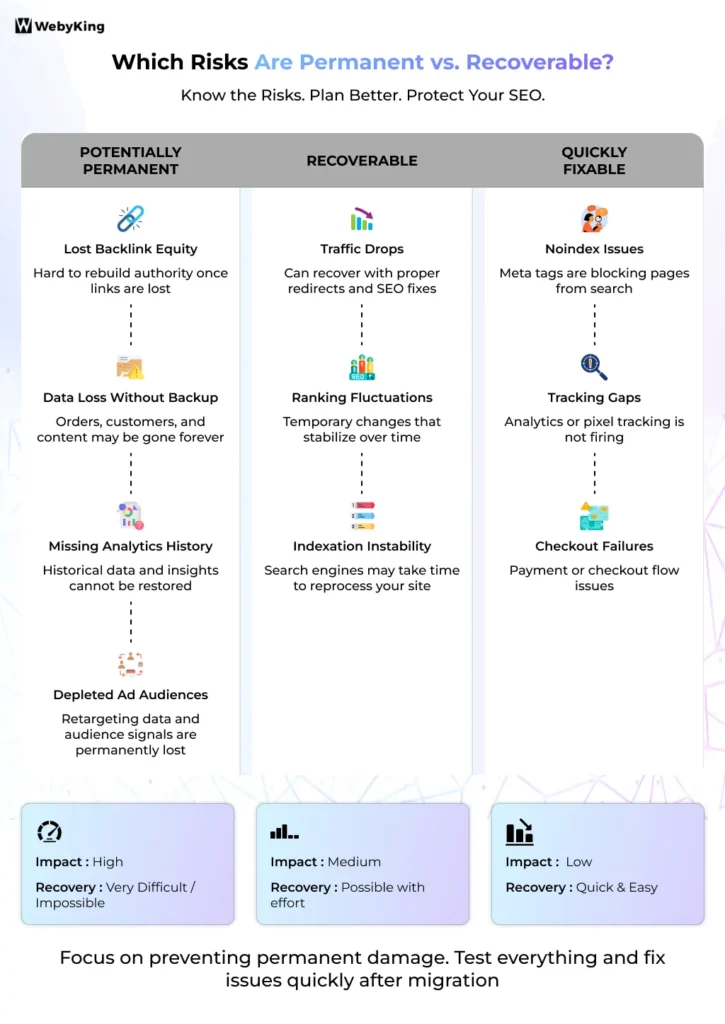
Which Risks Are Permanent vs. Recoverable?
Potentially Permanent
- Lost backlink equity
- Data loss without backup
- Missing analytics history
- Depleted ad audiences
Recoverable
- Traffic drops (with proper redirects)
- Ranking fluctuations
- Indexation instability
Quickly Fixable
- Noindex issues
- Tracking gaps
- Checkout failures
How These Risks Translate Into Real Business Impact
Website migration issues rarely exist in isolation.
A single mistake can trigger multiple downstream effects:
- Traffic drops → fewer leads → lower revenue
- Tracking failures → wasted ad spend → poor optimization
- Broken integrations → lost leads → missed opportunities
- Indexation issues → slower recovery → prolonged performance dip
The real risk isn’t just technical failure.
It’s how quickly small issues compound into measurable business loss.
Final Thought
Website migration rarely fails because of one major mistake. It fails when small issues go unnoticed and start compounding—affecting traffic, tracking, and overall performance without immediate visibility.
The real risk isn’t just what breaks at launch, but what quietly stops working weeks later. By the time it’s detected, the impact is already visible in lost rankings, missed data, or reduced revenue. Careful planning, validation, and post-launch monitoring are what separate a smooth migration from a costly setback.
Frequently Asked Questions

How long does recovery take?
Most sites stabilize within 2–8 weeks with proper implementation. Without it, recovery can take months.
Can migration permanently damage SEO?
Yes—especially when backlinks point to unredirected pages.
Do all migrations cause traffic drops?
Most cause temporary fluctuation. Severity depends on execution.
What is the highest-risk migration?
Domain changes (SEO) and platform migrations (technical). Combined, they carry the highest risk.
Is it safe to migrate before a major campaign?
No. Even minor issues can significantly impact revenue during critical periods.
Ravi Makhija, the visionary Founder and CEO of WebyKing, is a seasoned digital marketing strategist and web technology expert with over a decade of experience. Under his leadership, WebyKing has evolved into a premier full service web and marketing agency, delivering innovative solutions that drive online success. Ravi’s deep understanding of the digital landscape combined with his passion for cutting-edge technologies empowers him to consistently exceed client expectations and deliver results that matter.