


Most ecommerce platforms don’t fail overnight; they slowly start holding you back.
Pages take longer to load. Checkout feels clunky. Simple changes need developer time. And scaling starts to feel more complicated than it should be.
That’s usually when Shopify enters the conversation.
It’s not just about switching platforms; it’s about removing the friction that limits growth. But before making that move, the real question is: what exactly makes Shopify worth it?
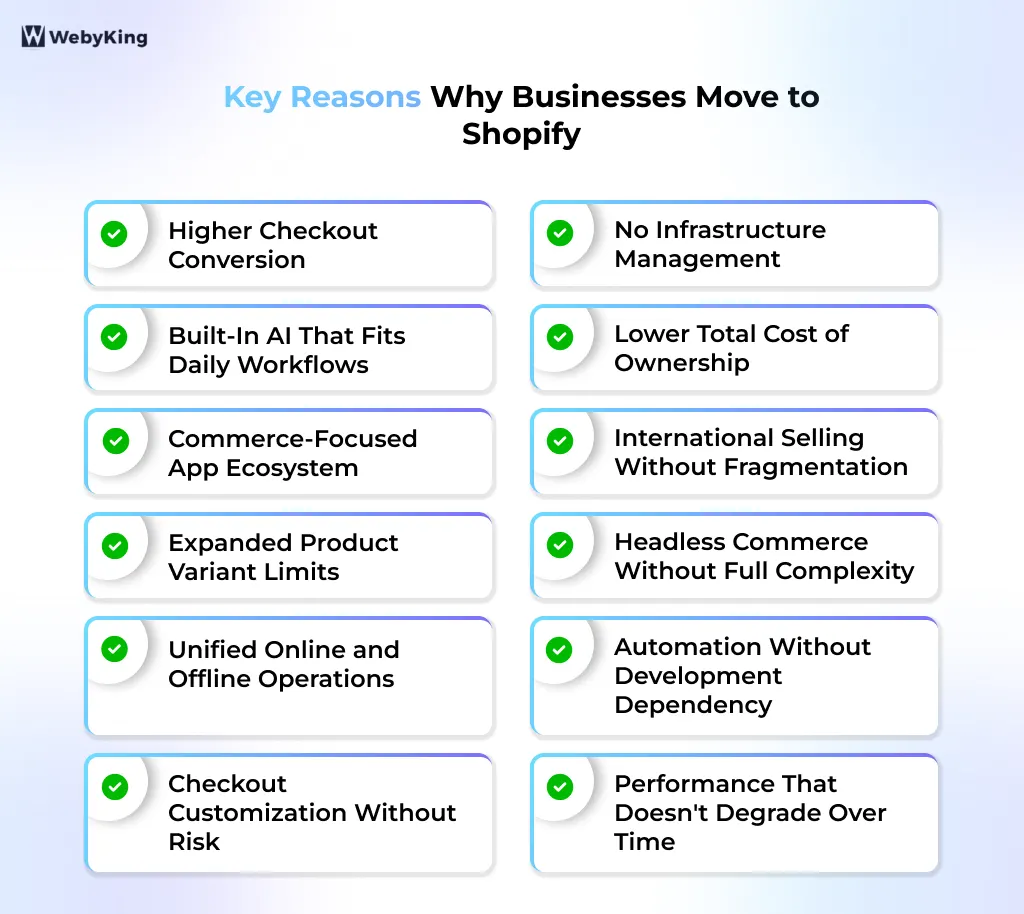
Here are the key reasons businesses are choosing Shopify in 2026 and where it actually makes a difference.
Shopify works best when simplicity and scalability matter more than full control. If you’re still evaluating your situation, understanding when it’s time to consider a website migration can help you make a more confident decision.
Checkout is where most stores lose revenue, and it’s also the hardest part to optimize on self-hosted platforms.
Shopify’s advantage comes from:
The key point isn’t just “better checkout,” it’s consistent performance without ongoing optimization work.
Even small improvements compound:
This is often the primary financial justification for migration.
Self-hosted platforms shift responsibility to you:
These are not one-time tasks; they are ongoing operational loads.
Shopify removes this layer entirely:
The real benefit isn’t convenience, it’s removing a category of risk and cost that doesn’t contribute to growth.
Time saved on maintenance can be redirected toward growth-focused activities.
Most platforms treat AI as an add-on. Shopify integrates it into the admin experience.
What matters here is usability:
The advantage is not just the capability, but it’s reduced dependency on multiple tools and manual effort.
This becomes more valuable as catalog size and operational complexity grow.
The misconception: Shopify is “more expensive” because it has a visible monthly fee.
The reality:
Shopify consolidates:
The key difference is cost predictability and reduced operational overhead, not just lower absolute cost.
The real saving comes from reduced developer dependency over time.
If you’re evaluating this seriously, understanding the actual website migration cost can help you set realistic expectations before making the move.
The size of the ecosystem matters less than its focus.
Shopify apps are built primarily for:
This leads to:
Compared to custom development, apps reduce both time-to-launch and long-term maintenance responsibility.
Selling internationally is where many platforms start to break down.
Common issues elsewhere:
Shopify centralizes:
The benefit is not just expansion, it’s avoiding operational fragmentation as you scale globally.
Variant limitations affect merchandising more than most teams expect.
When limits are too low:
Shopify’s expanded variant support (on advanced plans) allows:
This removes structural constraints that often appear only at scale.
Headless architecture gives flexibility, but usually increases complexity.
Shopify’s approach keeps:
This balance matters for teams that want customization without managing an entirely separate system.
Running separate systems for online and retail creates:
Shopify unifies:
The result is simpler operations and fewer points of failure, especially for growing omnichannel brands.
Manual processes don’t scale.
Without automation:
Shopify Flow enables:
The real value is freeing up time for higher-impact work, not just saving effort.
Customizing checkout on most platforms creates long-term maintenance risk.
Shopify separates:
This allows:
The key advantage is sustainable customization, not just customization itself.
Performance issues often grow gradually:
Shopify controls:
This leads to consistent performance without continuous optimization work, which directly impacts conversion and SEO.
Consistent performance directly supports both SEO rankings and conversion rates.
Instead of just listing features, here’s what typically improves when businesses switch to Shopify:
These improvements are why Shopify migration is often a growth decision, not just a technical one.
While Shopify works well for most growing ecommerce businesses, it’s not the right fit in every situation.
Shopify is not ideal when:
In these cases, flexibility may matter more than simplicity.
It’s also worth being aware of common website migration challenges that can impact performance, SEO, and operations if not handled properly.
Shopify is a strong choice if your current store is starting to create friction, whether that’s slower performance, increasing maintenance, or limits in scaling.
It makes the most sense when:
It’s not the right fit if:
If your store is becoming harder to manage as it grows, Shopify is often the step that simplifies operations and supports long-term scalability.
Migrating to Shopify makes the most sense when your current platform starts creating friction, whether that’s performance issues, rising maintenance effort, or limitations in scaling. At that stage, it becomes a growth decision, not just a technical one. Working with the right website migration service helps ensure the transition is smooth, without impacting SEO, traffic, or revenue.
At the same time, long-term success depends on how well your store is built after migration. If you’re planning a move, working with an experienced team like WebyKing can help you migrate with confidence and build a store that’s ready to scale.
I'm Ravi Makhija, Founder & CEO of WebyKing. I believe your website should be the hardest-working member of your team, building trust, generating leads, and creating opportunities 24/7. Through web design, development, SEO, and digital strategy, I help businesses build websites that become growth assets-not just digital brochures. Too many businesses invest in websites that look great but fail to deliver real business value.
Business owners deserve digital solutions that are simple, practical, and built around their goals, not unnecessary complexity. After all, your website shouldn't just represent your business; it should help grow it.

Let’s turn your ideas into impact—reach outYears of Experience and let’s build something exceptional together.
Customer
Retention Ratio
Certified Professionals
Projects
Years of Experience







TRUSTED BY 100+ CLIENTS, WITH OVER 100 PROJECTS SUCCESSFULLY DELIVERED AS A FULL-SERVICE WEB AGENCY
TRUSTED BY 100+ CLIENTS, WITH OVER 100 PROJECTS SUCCESSFULLY DELIVERED AS A FULL-SERVICE WEB AGENCY
TRUSTED BY 100+ CLIENTS, WITH OVER 100 PROJECTS SUCCESSFULLY DELIVERED AS A FULL-SERVICE WEB AGENCY
We don’t just build websites; we craft digital experiences that drive results. Contact us today, and let’s turn your online presence into a powerful marketing tool that grows your business.
Web Design By Industry
Digital Marketing
eCommerce Web Design
SEO Services
Lead Gen By Industry
Migration By Platform
PPC By Industry
Maintenance By Platform
Our Presence
Expand your business digitally on a global scale! We’re always ready at your service, with dedicated teams in three key international locations.

5354 Denny Ave, North Hollywood, Los Angeles, CA 91601, United States.
9720 Jones Rd, S210, Houston, TX 77065, United States.

The Spire, Office No: 312, Near Ayodhya Chowk BRTS Bus Stop, 150 Feet Ring Road, Rajkot
Share your details below and we’ll get back to you soon.
We’ll get back to you shortly.