Last Updated: July 29, 2026
Reading Time: 15 minutes
Post Views: 706
- What Is Website Marketing?
- Who This Guide Is For
- The 3-Layer Website Marketing Framework
- The Core Website Marketing Channels
- AEO & GEO: Get Your Business Cited by AI Search Engines
- How Do You Measure Website Marketing Success?
- Your Website Marketing Strategy: A 30-Day Roadmap
- DIY vs. Hiring a Website Marketing Expert: An Honest Comparison
- Key Takeaways
- Final Thoughts
- Frequently Asked Questions About Website Marketing
Your website is working against you right now — and you probably don’t know it.
Not because it’s poorly designed. Not because your product isn’t good. But because 68% of all online experiences still begin with a search engine, and if your site isn’t showing up, your competitors are getting those customers instead.
If you’ve ever wondered how to promote a website, the answer isn’t one tactic — it’s a complete system that combines SEO, content, ads, and conversion strategy.
Website marketing is how you fix that. This guide breaks down every channel that actually moves the needle in 2026 — search engine optimization, content marketing, email, paid ads, social, CRO, and the emerging AI-search signals that are quietly reshaping how businesses get found online. Whether you’re starting from scratch or fixing a strategy that’s stalled, you’ll finish this guide with a clear, prioritized action plan.
Let’s start with what website marketing actually means — and what it doesn’t.
What Is Website Marketing?
Website marketing is the process of attracting visitors to your website and converting them into leads, customers, or revenue through channels such as SEO, content marketing, email marketing, paid advertising, social media, and conversion optimization.
It’s not a single tactic. It’s not just SEO, and it’s not just running ads. Website marketing is the system that connects every channel — organic search, content, email, paid advertising, social media, and conversion optimization — into one strategy that works together instead of in silos.
What it’s NOT: posting on social media without a goal, running Google Ads without tracking conversions, or publishing blog posts with no distribution plan. Those are activities. Website marketing is the strategy that makes those activities produce results.
In 2026, effective website marketing also means being found by AI-powered search engines — Perplexity, ChatGPT Search, and Google’s AI Overviews — not just traditional search results. More on that in Section 7.
Who This Guide Is For
Website marketing looks different depending on where you are right now. Find your situation below — each one points you to the sections that matter most.
You’re building your online presence from scratch. You have a website but almost no traffic. Prioritize Sections 3 (SEO), 4 (Content), and 8 (30-day roadmap). These build the foundation on which everything else runs.
You have traffic, but it’s not converting. People land on your site and leave without doing anything. Go straight to Section 6 (CRO) and Section 8. The problem is rarely the marketing — it’s what happens after the click.
You’ve tried marketing before and seen little ROI. You’ve run ads, maybe hired someone, and the results didn’t justify the spend. Read Sections 2 (framework), 3, 4, and 6 in that order. The issue is almost always a strategy gap, not a channel gap — you’re spending before the foundation is ready.
The 3-Layer Website Marketing Framework
Before jumping into channels, you need a mental model — because most businesses fail at website marketing, not because they chose the wrong channel, but because they used the right channel at the wrong stage.
This framework is the foundation of any effective website marketing strategy or broader online marketing strategy.
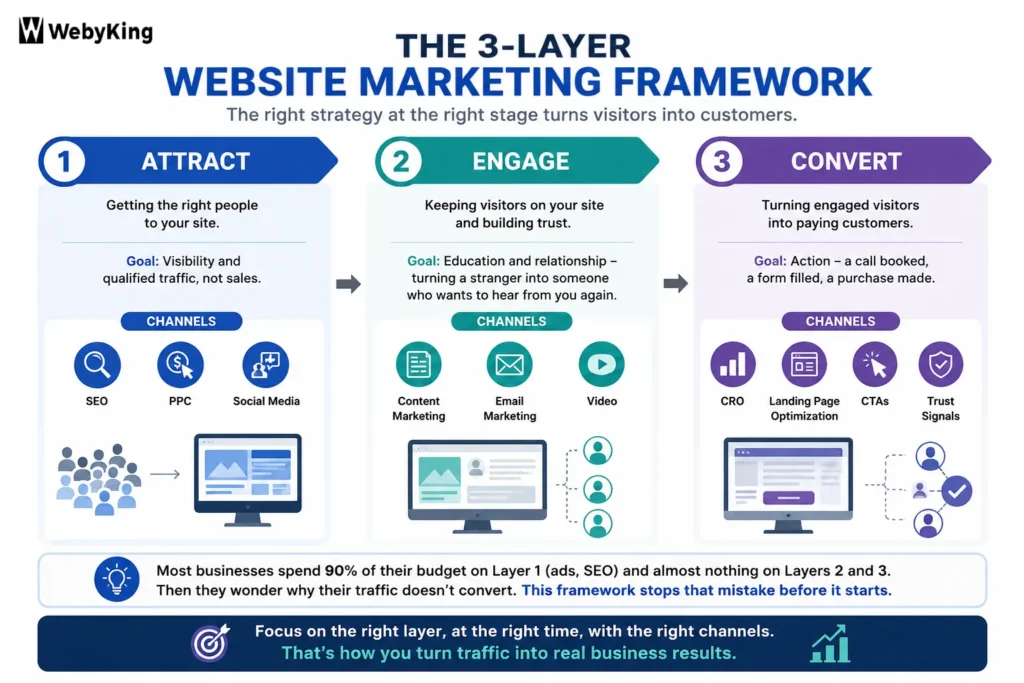
Every website marketing strategy operates across three layers:
Layer 1 - Attract.
Getting the right people to your site. Channels: SEO, PPC, social media. The goal here is visibility and qualified traffic, not sales.
Layer 2 - Engage.
Keeping visitors on your site and building trust. Channels: content marketing, email marketing, video. The goal here is education and relationship — turning a stranger into someone who wants to hear from you again.
Layer 3 - Convert.
Turning engaged visitors into paying customers. Channels: CRO, landing page optimization, CTAs, trust signals. The goal here is action — a call booked, a form filled, a purchase made.
Most businesses spend 90% of their budget on Layer 1 (ads, SEO) and almost nothing on Layers 2 and 3. Then they wonder why their traffic doesn’t convert. This framework stops that mistake before it starts.
Every channel covered in this guide maps to one of these three layers. That’s how you’ll know where to invest first — and why.
The Core Website Marketing Channels
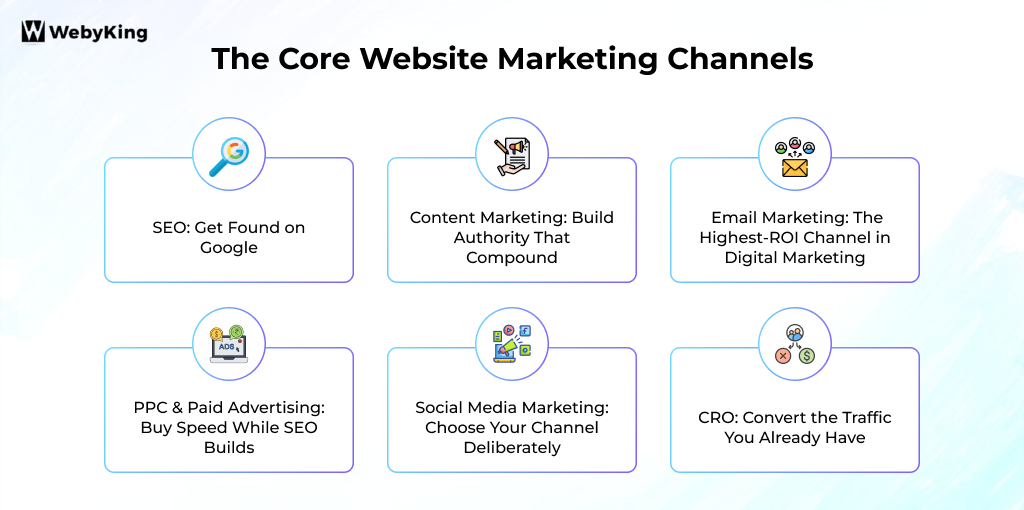
1. SEO: Get Found on Google (Layer 1 — Attract)
SEO (search engine optimization) is the process of earning organic rankings in search results so your website appears when potential customers search for what you offer, without paying for every click.
SEO delivers the highest long-term ROI of any digital marketing channel. According to HubSpot’s 2026 State of Marketing report, website/blog/SEO is ranked as the #1 ROI-generating channel among marketers, highlighting the impact of blogging and organic search. Unlike paid ads, SEO compounds — a page that ranks today can continue driving traffic for months or even years.
What actually moves rankings in 2026:
- Keyword clustering over single keywords. Instead of targeting “website marketing,” you build content around a cluster: website marketing strategy, website marketing plan, how to market a website, and even queries like how to promote a website? One strong pillar page can rank for dozens of related queries simultaneously.
- E-E-A-T signals. Google’s quality evaluators score pages on Experience, Expertise, Authoritativeness, and Trust. Practically, this means: your author bio needs real credentials, your content needs original data or case studies, and your site needs credible backlinks.
- Search intent match. Every query has an intent — informational, commercial, navigational, or transactional. If someone searches “how to market a website,” they want a guide, not a pricing page. Mismatching intent is the fastest way to drop rankings even with a well-optimized page.
- Technical foundations. Core Web Vitals (especially Largest Contentful Paint), mobile-first indexing, clean site architecture, and internal linking all affect how well Google can crawl and rank your content.
The most common SEO mistake:
Targeting high-volume keywords before your site has any authority. New sites should start with long-tail, low-competition keywords and build domain authority before going after competitive head terms.
2. Content Marketing: Build Authority That Compounds (Layer 2 — Engage)
Content marketing is the strategy of creating and distributing useful, relevant content that attracts your target audience, builds trust over time, and positions your business as the go-to authority in your space. This is what turns your blog into a scalable online marketing guide that attracts and nurtures your audience over time.
According to the Content Marketing Institute’s B2B Content Marketing report, around 80% of top-performing B2B companies have a documented content strategy. Which businesses are seeing the worst content ROI? They publish without a plan and distribute nowhere.
The pillar-cluster model is the only content structure worth building in 2026:
One comprehensive pillar page covers the broad topic. Supporting cluster posts go deep on each sub-topic, like SEO, email marketing, CRO, PPC, and link back to the pillar. This architecture signals topical authority to Google and keeps visitors on your site longer.
Content formats that work by business type:
- Local service businesses: case studies, before/after project posts, local SEO landing pages
- SaaS/tech: how-to guides, comparison posts, integration tutorials
- E-commerce: product guides, buying guides, user-generated content
- B2B: research reports, thought leadership, client success stories
The repurposing multiplier:
One long-form blog post becomes five assets — a LinkedIn article, three social media posts, an email newsletter, a short video script, and a downloadable checklist. That’s five pieces of content from one hour of writing.
The most common content mistake:
Writing for search engines instead of for people. Google’s Helpful Content system now actively downgrades content that exists primarily to rank — not to help. Write for your reader first. Rankings follow.
3. Email Marketing: The Highest-ROI Channel in Digital Marketing (Layer 2 — Engage)
Email marketing is the practice of building a list of opted-in subscribers and communicating with them directly — nurturing leads, driving repeat purchases, and building the kind of loyalty that paid ads can never buy.
Here’s the number that stops most business owners cold: email marketing returns $42 for every $1 spent, according to the DMA’s 2025 email marketing report. No other channel comes close at that ratio.
The four-part email system that drives results:
- List building. A lead magnet (free guide, template, checklist, discount) in exchange for an email address. Paid traffic without list building is traffic you rent — you lose it the moment the budget stops.
- Welcome sequence. The first 5–7 emails after someone subscribes. This is where trust is built or broken. Most businesses send one “welcome” email and go silent. The sequence should deliver immediate value, share your story, and introduce your services naturally.
- Segmentation. Not everyone on your list wants the same thing. A new visitor and a past customer need different messages. Basic segmentation by interest or purchase history can double open rates and triple click-through rates.
- Automation triggers. Emails sent based on behavior, not just time. Someone who visited your pricing page three times gets a different message than someone who opened your last newsletter.
The most common email mistake:
Building a list and sending one-off promotional blasts with no sequence and no segmentation. This trains subscribers to ignore you — and eventually unsubscribe.
Not sure which of these channels to prioritize for your business?
That’s exactly where most businesses get stuck — not for lack of effort, but for lack of a clear starting point. Our team at WebyKing works with businesses across industries to build website marketing strategies that are sequenced correctly from day one.
(no pitch — just a clear picture of where to start)
4. PPC & Paid Advertising: Buy Speed While SEO Builds (Layer 1 — Attract)
PPC (pay-per-click) advertising is the practice of paying for placement in search results or social feeds — getting immediate visibility while your organic strategy builds momentum.
SEO takes 3–6 months to show meaningful results. PPC delivers traffic on day one. That’s not a reason to choose one over the other — it’s a reason to run both simultaneously, with different roles.
When PPC beats SEO:
- Launching a new product or service with no organic presence yet
- Targeting transactional queries (“hire website marketing agency near me”)
- Promoting time-sensitive offers or events
- Retargeting visitors who’ve already been to your site
A practical budget framework for small and mid-size businesses:
| Monthly budget | Recommended approach |
| Under $500 | Focus entirely on SEO and content. PPC at this budget rarely covers testing costs. |
| $500–$2,000 | Google Search Ads for your 3–5 highest-intent keywords only. No broad match. |
| $2,000–$5,000 | Google Search + retargeting on Meta. Begin testing landing page variants. |
| $5,000+ | Full funnel: search, display, retargeting, lookalike audiences, A/B testing at scale. |
Retargeting is non-negotiable at any budget above $500/month. 97% of first-time website visitors don’t convert. Retargeting ads follow those visitors across the web — keeping your brand visible and pulling them back when they’re ready to act. Cost per conversion on retargeting campaigns is typically 3–5× lower than cold traffic campaigns.
The most common PPC mistake:
Sending paid traffic to your homepage. Always send paid traffic to a dedicated landing page with one clear goal and no navigation menu. Every additional link is a leak in your conversion funnel.
5. Social Media Marketing: Choose Your Channel Deliberately (Layer 1 — Attract)
Social media marketing is the use of social platforms to build brand awareness, distribute content, engage your audience, and drive traffic back to your website — with platform selection determined by where your specific audience actually spends time.
The most expensive social media mistake isn’t choosing the wrong content. It’s choosing the wrong platform and spending six months building an audience you can never convert.
Platform selection by business type:
| Business type | Primary platform | Why |
| Local service businesses | Google Business Profile + Facebook | Local intent + community targeting |
| SaaS / B2B tech | LinkedIn + YouTube | Professional audience + long-form trust-building |
| E-commerce | Instagram + TikTok | Visual discovery + impulse-driven purchase behavior |
| Professional services | LinkedIn + Twitter/X | Thought leadership + direct client access |
| Hospitality/lifestyle | Instagram + Pinterest | Aspirational visual content drives direct bookings |
The organic vs. paid decision rule:
Use organic social for community building, brand voice, and content distribution. Use paid social for audience expansion and retargeting. Organic alone rarely drives meaningful website traffic in 2026 — platform algorithms heavily suppress non-promoted content. Treat organic as a credibility layer; treat paid as a traffic driver.
The most common social media mistake:
Treating all platforms the same. Content that performs on LinkedIn will fall flat on TikTok — and vice versa. Each platform has its own native content format, posting rhythm, and audience expectation. Adapt, don’t copy-paste.
6. CRO: Convert the Traffic You Already Have (Layer 3 — Convert)
Conversion rate optimization (CRO) is the practice of improving your website so a higher percentage of visitors take the action you want — booking a call, filling a form, making a purchase — without increasing your traffic spend.
Most businesses are addicted to traffic. They spend thousands every month on ads and SEO to get more visitors — while ignoring the fact that their existing traffic converts at 1–2% when the industry average for optimized sites is 3–5%.
Doubling your conversion rate is the equivalent of doubling your traffic — without spending an extra dollar on ads.
The three highest-impact CRO levers:
- Your headline. The first thing a visitor reads determines whether they stay or leave. Most headlines describe what a business does (“We Build Websites”). High-converting headlines describe what the customer gets (“Get a Website That Actually Brings You Leads”). Test this first — it moves the needle more than any other single element.
- Trust signals above the fold. Reviews, client logos, certifications, and real numbers (“Helped 200+ businesses rank on page one”) placed where visitors see them within the first scroll. Trust is built in the first 5 seconds or lost.
- One clear CTA per page. Every additional CTA on a page splits attention and reduces conversion. A homepage with “Book a Call,” “See Our Work,” “Read Our Blog,” and “Get a Quote” is asking visitors to make four decisions simultaneously. Pick one primary action per page.
Real Result — Market Baby (E-commerce):
Market Baby, an online baby food retailer selling brands like Similac, Enfamil, and Gerber, was struggling to turn website visitors into buyers despite offering quality products and a wide catalogue. WebyKing rebuilt their Shopify storefront with a sharper focus on conversion fundamentals — cleaner product pages, clearer calls to action, and trust signals integrated throughout the purchase journey. The outcome: a +200% increase in conversion rate and +35% growth in monthly leads. Same traffic. Dramatically more revenue — simply by fixing what happened after the click.
The most common CRO mistake:
A/B testing colors and button sizes before fixing your headline and value proposition. Test the big things first — copy, layout, CTA placement — before optimizing micro-elements.
Is your website converting the traffic it already gets?
Most businesses are losing leads from visitors who were already interested. We offer a free homepage CRO audit — a 15-minute review of your site’s conversion fundamentals with specific, actionable fixes.
(limited to 10 audits per month)
AEO & GEO: Get Your Business Cited by AI Search Engines
What Is AEO (Answer Engine Optimization)?
AEO is the practice of structuring your content so it gets cited as a direct answer by AI-powered search engines — including Google’s AI Overviews, Perplexity, ChatGPT Search, and Bing Copilot.
Traditional SEO gets you ranked. AEO gets you cited — your content becomes the source that AI engines pull from when someone asks a question your content answers. According to a 2025 BrightEdge study, AI Overviews now appear in 42% of all Google searches. That’s 42% of searches where the cited source gets visibility without the user ever clicking a blue link.
What Is GEO (Generative Engine Optimization)?
GEO is the practice of optimizing your content to be referenced, summarized, or recommended by generative AI platforms — not just traditional search engines.
Where AEO focuses on Google’s AI layer, GEO is broader: it’s about making your content citation-worthy across all generative AI tools. When someone asks ChatGPT “what’s the best website marketing strategy for a small business,” GEO is what determines whether WebyKing gets mentioned — or a competitor does.
How to Implement AEO and GEO: 5 Steps
Step 1 — Write direct-answer blocks.
Every major section of your content should open with a 40–60 word answer to the implied question. Start with “X is…” or “X means…” AI engines pull these blocks verbatim.
Step 2 — Add FAQ schema markup.
Your FAQ section needs JSON-LD structured data so Google’s systems can read and surface your answers as featured snippets and AI Overview sources. This is a 30-minute technical task with disproportionate impact.
Step 3 — Optimize for entities, not just keywords.
AI platforms understand topics through related entities — named concepts, people, tools, and organizations that belong to a subject. For website marketing, those entities include: conversion rate, buyer persona, CAC, LTV, attribution model, first-party data, and Google Analytics. Content that contains these entities signals topical completeness to AI systems.
Step 4 — Cite credible, dated sources.
AI platforms heavily favor content that cites named, verifiable sources with publication dates. AI engines use source quality as a proxy for content reliability.
Step 5 — Use question-based H2 and H3 headings.
“What is AEO?” and “How does GEO work?” are more likely to be pulled as AI answers than “AEO Overview” or “GEO Explained.” Questions match the way people actually type into AI search interfaces.
How Do You Measure Website Marketing Success?
Website marketing should be measured by business outcomes, not just traffic. While traffic is an important leading indicator, the most valuable metrics show whether your website is generating leads, customers, and revenue.
Key metrics to track include:
- Organic traffic growth
- Lead generation
- Conversion rate
- Cost per lead (CPL)
- Customer acquisition cost (CAC)
- Email subscriber growth
- Revenue generated from marketing channels
A successful website marketing strategy improves both visibility and conversions over time. Focus on trends and business impact rather than vanity metrics alone.
Your Website Marketing Strategy: A 30-Day Roadmap
This roadmap acts as a practical online marketing guide you can follow step by step.
Week 1 — Audit and Foundation
- Google Analytics 4 + Google Search Console: Set up or verify both are installed and tracking. You cannot optimize what you don’t measure.
- Technical SEO audit: Check Core Web Vitals (free via PageSpeed Insights), fix broken links, verify mobile-friendliness.
- Keyword research: Identify your 5 most important target keywords using Google Search Console (queries you already rank for) + Google’s “People Also Ask” boxes.
- Google Business Profile: Claim and complete your profile if you serve local customers. This is the fastest win for local visibility.
Week 2 — Content and On-Page SEO
- Audit your top 5 pages: Do the H1, meta description, and first paragraph match the keyword intent? Fix mismatches before creating new content.
- Write or rewrite one pillar page: Your most important topic, covered comprehensively. This is where topical authority begins.
- Set up an email capture: One lead magnet (a checklist, guide, or template relevant to your audience) with a simple opt-in form above the fold on your homepage.
Week 3 — Distribution and Promotion
- Email welcome sequence: Write a 3-email welcome sequence for new subscribers: (1) deliver the lead magnet + introduce your story, (2) share your most useful piece of content, (3) soft introduction to your services.
- Social media: Share your pillar page content across the platform(s) where your audience is. Adapt the format — don’t copy-paste.
- Outreach: Email 5–10 relevant websites, podcasts, or newsletters about your pillar page content. One mention or backlink from a credible source moves rankings faster than 10 blog posts.
Week 4 — Conversion and Measurement
- Homepage CRO: Rewrite your headline to focus on customer outcome, not business description. Add trust signals above the fold. Ensure one clear primary CTA.
- Review your analytics: Which pages have traffic but low time-on-page? Those are engagement problems. Which pages have good time-on-page but no conversions? Those are CRO problems.
- Set your 90-day targets: Traffic goal, lead goal, conversion rate goal. These become the KPIs you review every month.
DIY vs. Hiring a Website Marketing Expert: An Honest Comparison
| Factor | DIY | Working with an expert |
| Cost | Lower upfront | Higher upfront, lower cost-per-result |
| Speed to results | 6–12 months | 2–4 months |
| Learning curve | High — each channel takes months to master | None — expertise is already there |
| Strategy coherence | Depends on your knowledge | Built in from day one |
| Best for | Solopreneurs with time and appetite to learn | Businesses that need results faster than they can learn |
The honest truth: most of the businesses we work with at WebyKing tried DIY first. Not because they couldn’t learn — but because learning takes time that their business couldn’t afford. When the cost of staying invisible exceeds the cost of hiring an expert, that’s when it’s time to bring someone in.
There’s no wrong answer here. This guide gives you everything you need to execute this strategy yourself. If at any point you want expert support — we’re here.
You've read the whole guide. Most business owners stop here.
The strategy is clear. The channels are mapped. The 30-day roadmap tells you exactly what to do first.
The only question is: do you want to execute this yourself, or do you want a team that’s already done it for hundreds of businesses?
At WebyKing, we build and execute website marketing strategies that are sequenced correctly, measured properly, and built to compound over time — not just drive traffic for 30 days.
Tell us where you are, and we’ll show you what the path forward looks like. No obligation, no pitch deck. Just clarity.
Key Takeaways
- Website marketing works best when SEO, content, email, paid ads, and CRO support one another instead of operating separately.
- Build your strategy in three stages: attract the right audience, engage them with valuable content, and optimize your website for conversions.
- Create helpful, people-first content and prepare your website for both traditional search engines and AI-powered search experiences.
- Measure success using business metrics like leads, conversions, and revenue—not just website traffic.
- Consistent optimization and a structured marketing plan deliver stronger long-term results than relying on a single channel.
Final Thoughts
Website marketing in 2026 isn’t about hacking an algorithm or finding the one channel that changes everything. It’s about building a system — attracting the right people, engaging them with content that earns trust, and converting them with a site that’s optimized to act on that trust.
The businesses that win aren’t the ones with the biggest budget. They’re the ones who understand the framework, execute the fundamentals correctly, and keep showing up.
You now have both the map and the compass. What you do next is up to you.
Frequently Asked Questions About Website Marketing
What is the difference between website marketing and digital marketing?
Digital marketing covers all online marketing activity, including mobile apps, streaming platforms, and connected devices. Website marketing is specifically focused on driving traffic to and converting visitors on your website. Website marketing is a subset of digital marketing.
How long does it take for website marketing to show results?
It depends on the channel. PPC and email marketing can show results within days. SEO typically takes 3–6 months to produce meaningful organic traffic. Content marketing takes 6–12 months to build compounding authority. Most businesses see the strongest overall results at the 6-month mark when multiple channels are running simultaneously.
How much should a small business spend on website marketing?
A commonly cited benchmark is 7–10% of annual revenue for established businesses, and 12–20% for businesses in growth mode. For a business generating $500,000 annually, that’s $35,000–$50,000 per year — or roughly $3,000–$4,000 per month across all channels. Start with the channels that match your current stage, not the biggest budget you can afford.
What is the most important website marketing channel for a new business?
SEO and content marketing, followed closely by email list building. These three work together: SEO brings the traffic, content converts that traffic into subscribers, and email nurtures those subscribers into customers. Paid ads before these foundations are in place is a common and expensive mistake.
What is AEO and why does it matter in 2026?
AEO (Answer Engine Optimization) is the practice of structuring content to be cited by AI-powered search tools like Google’s AI Overviews, Perplexity, and ChatGPT Search. As AI search becomes the primary way people find information online, content that isn’t optimized for AI citation will lose visibility — even if it ranks well in traditional search.
Do I need to be on every social media platform?
No. Being present on every platform and doing nothing well is worse than mastering one platform. Choose the platform where your specific audience is most active and where the content format matches what you can consistently produce. For most businesses, one or two platforms done well outperforms five platforms done poorly.
What is the best way to promote a website?
The best way to promote a website is through a combination of SEO, content marketing, email marketing, and paid advertising. A well-structured online marketing strategy ensures that each channel works together to attract, engage, and convert visitors over time.
I'm Ravi Makhija, Founder & CEO of WebyKing. I believe your website should be the hardest-working member of your team, building trust, generating leads, and creating opportunities 24/7. Through web design, development, SEO, and digital strategy, I help businesses build websites that become growth assets-not just digital brochures. Too many businesses invest in websites that look great but fail to deliver real business value.
Business owners deserve digital solutions that are simple, practical, and built around their goals, not unnecessary complexity. After all, your website shouldn't just represent your business; it should help grow it.


Need Help Marketing Your Website the Right Way?