Last Updated: August 22, 2026
Reading Time: 10 minutes
Post Views: 301
- SEO Pricing at a Glance
- SEO Cost by Business Size
- What a Monthly SEO Retainer Includes
- How Much Should You Budget?
- What Affects SEO Pricing
- SEO Cost by Industry
- Costs Beyond the Monthly Retainer
- In-House vs. Agency: Which Costs More?
- How SEO Pricing Is Changing in 2026
- How to Tell If Your Quote Is Fair
- SEO Pricing Red Flags
- When Will You See Results?
- Is SEO Worth the Cost?
- SEO Cost Calculator: Get Your Personalized Budget Estimate
- How WebyKing Approaches SEO Pricing
- Final Takeaway
- Frequently Asked Questions
Key Takeaways
- Most small and midsize businesses plan for $1,000–$5,000 a month. Local campaigns can start near $500. Competitive national or enterprise campaigns often run $10,000–$50,000+ a month.
- Across major 2026 surveys, the average agency retainer sits around $3,200 a month, but the numbers vary widely by source.
- Price alone won’t tell you if a quote is fair. Scope, deliverables, and who does the work matter more than the number.
- SEO in 2026 now includes visibility inside AI answers (GEO/AEO), not just classic rankings.
- The monthly fee isn’t the whole cost. Tools, development, and content can sit on top of it.
For most small and midsize businesses, a realistic SEO budget is $1,000–$5,000 a month. Local businesses often start at $500–$1,500. Competitive national, ecommerce, SaaS, legal, and enterprise campaigns can run $5,000–$20,000+ a month.
There is no single SEO price. Your cost depends on how competitive your market is, how much work your site needs, how many locations you target, how much content you need, and which services you require.
The surveys back this up, and they disagree. Ahrefs polled 439 providers and found an average agency retainer of about $3,209 a month, with the most common range being $501–$2,000. Clutch puts the average near $3,199. SE Ranking, on the other hand, found 64% of agencies charge under $1,000. The averages differ by almost 3x, mostly because a few enterprise agencies charge $10,000+ and pull the average up. So treat any headline number as a starting point, not a quote.
SEO Pricing at a Glance
| SEO Pricing Model | Typical Range | Best For |
| Monthly SEO | $500–$5,000+/month | Ongoing optimization and growth |
| Local SEO | $500–$2,000+/month | Local and multi-location businesses |
| SEO Consulting | $75–$300+/hour | Strategy, audits, troubleshooting |
| SEO Audit | $500–$5,000+ | Finding technical and search problems |
| Project-Based SEO | $1,000–$10,000+ | Defined projects or migrations |
| Enterprise SEO | $10,000–$50,000+/month | Large sites and tough markets |
These are planning ranges, not fixed prices. The same budget can buy very different results depending on the provider.
SEO Cost by Business Size
The easiest way to estimate your budget is to start with how complex your business is.
| Business Type | Typical Budget | Common SEO Needs |
| Very small/local | $500–$1,500/month | Local SEO, technical fixes, on-page work |
| Small business | $1,000–$3,000/month | Content, technical SEO, local/national work |
| Growing business | $2,500–$5,000/month | Content strategy, technical SEO, authority |
| Competitive national | $5,000–$10,000+/month | Heavy content, technical work, digital PR |
| Enterprise / ecommerce | $10,000–$50,000+/month | Large-scale technical, international, content |
A five-page local site doesn’t need the same work as a 5,000-page store. So the better question isn’t “How much does SEO cost?” It’s “How much work does my site need to compete for searches that bring revenue?”
What a Monthly SEO Retainer Includes
Pricing makes more sense once you know what you’re paying for. A real ongoing engagement usually covers some mix of the work below.
| SEO Activity | What It Covers |
| Strategy | Choosing the right priorities for your goals |
| Keyword research | Finding searches worth targeting |
| Technical SEO | Crawling, indexing, structure, and speed |
| On-page SEO | Titles, headings, content, and internal links |
| Content | Blog posts, service pages, and landing pages |
| Local SEO | Google Business Profile, local pages, reviews |
| E-commerce SEO | Category, product, and technical optimization |
| Authority building | Earning relevant mentions and links |
| Analytics | Tracking traffic, leads, and conversions |
| Reporting | Showing what changed and what’s next |
No two packages include everything. That’s why two agencies both charging $2,000 a month can deliver very different work. When you compare quotes, compare the scope, not just the price.
How Much Should You Budget?
Match your budget to how competitive your market is.
$500–$1,500 a month
This works for small local businesses, low-competition markets, and sites with a solid technical base. Keep the focus narrow. You can’t expect deep technical work, heavy content, and aggressive link building all at once on this budget.
$1,500–$3,000 a month
A workable range for many growing businesses. It can cover technical fixes, keyword and competitor research, on-page work, content, internal linking, local SEO, and reporting.
$3,000–$5,000 a month
A better fit once competition rises. You’re paying for more content, deeper technical work, competitive analysis, stronger link building, and more strategy.
$5,000+ a month
This makes sense when SEO is a major growth channel or you compete nationally. The scope can include large content operations, enterprise technical SEO, digital PR, ecommerce and international SEO, and AI-search tracking.
The goal isn’t to spend more. It’s to fund enough quality work to compete.
What Affects SEO Pricing

1. Competition
2. Website size
A small site is easier to fix than one with thousands of URLs, many locations, or heavy JavaScript. More pages and more complexity mean more work.
3. Geography
Targeting one city is different from targeting a country. Costs rise as you go from one city, to several, to a region, to national, to international. Each new market adds competitors and content.
4. Content needs
If your site already has strong commercial pages, your content budget can be lower. If you’re missing lots of pages, content creation becomes a bigger cost.
Two things raise content cost in 2026. First is E-E-A-T (experience, expertise, authority, trust). Content with named authors, real expertise, and original data costs more than generic filler, and it’s what both Google and AI answers reward. Second is topical authority. Covering a subject fully across related pages now matters more than chasing one keyword, so campaigns often need more content.
5. Technical condition
A healthy site lets more budget go to growth. A site with indexing, speed, or duplicate-content problems needs technical work first.
6. Who does the work
Freelancers, consultants, and agencies price differently. Ahrefs’ 2026 data puts average hourly rates near $72 for freelancers, $99 for agencies, and $171 for consultants. Retainer ranges have also compressed a little since 2024, because AI now handles routine tasks like keyword research and first drafts. That shifts the cost toward the work AI can’t do well: strategy, editing, and authority building.
SEO Cost by Industry
Use industry as a guide, not a fixed price.
| Industry | Planning Range | Main Cost Drivers |
| Local services | $500–$2,500/month | Local competition and service areas |
| Real estate | $1,500–$5,000+/month | Location pages and local competition |
| Ecommerce | $2,000–$10,000+/month | Catalog size and technical complexity |
| Healthcare | $2,000–$8,000+/month | Content quality, local search, trust |
| Legal / finance | $3,000–$10,000+/month | Very competitive commercial terms |
| SaaS / technology | $3,000–$12,000+/month | Content depth and authority |
A small local law firm and a national legal marketplace need very different work. Our guide to SEO for lawyers covers that industry in more detail.
Costs Beyond the Monthly Retainer
The monthly fee often isn’t the whole cost.
SEO tools
Professional work needs tools for keyword research, rank tracking, audits, backlinks, and analytics. Most cost $100–$500 a month each. For an in-house team, this adds up.
New in 2026 is a set of AI-visibility tools. These track whether ChatGPT, Google AI Overviews, Perplexity, and Gemini mention or cite your brand. Tools like Ahrefs Brand Radar, Otterly.ai, Profound, and Rankscale do this. Regular rank trackers can’t see inside AI answers, so budget for one if AI search matters to you.
Website development
Sometimes SEO finds problems that need a developer: site speed, indexing, URL changes, redirects, or structured data. This may be included, billed separately, or handled by your team. Ask before you sign.
Content
Some packages include content and others charge extra. Ask how many pieces, who writes them, whether editing is included, and who owns the work.
Digital PR and authority
Off-page SEO has changed in 2026. Digital PR has mostly replaced bulk link building. A lot of the work is now about earning brand mentions, not just links. Mentions without a link, reviews, and real presence in places like Reddit all shape how search engines and AI systems judge your authority. The same trust signals that help you rank also help AI answers cite you. Bulk paid links are still a risk and buy little. So when you pay for authority building, you’re paying for outreach and earned coverage, not a link count.
In-House vs. Agency: Which Costs More?
Hiring in-house makes sense when SEO is central to your business. But salary isn’t the only cost. An internal team also needs benefits, software, content help, developers, and training.
An agency spreads specialists across a team, which suits businesses that don’t need a full department. So the real comparison isn’t salary vs. agency fee. It’s the total cost of building the capability yourself vs. the scope you get from an outside team.
How SEO Pricing Is Changing in 2026
SEO in 2026 isn’t only about blue-link rankings. Search now includes AI answers and summaries, and the shift is real. Traditional search volume is falling, and studies show ChatGPT drives most of the traffic that comes from AI search tools. Research also shows that clicks on AI-cited sources can be very low. That’s why brands now think about visibility and citations, not just rankings.
This doesn’t mean classic SEO is over. Useful content, clean technical work, authority, and relevance all still matter. What’s changed is the number of places a brand can show up.
You’ll hear this work called GEO (Generative Engine Optimization) or AEO (Answer Engine Optimization). The simplest way to tell them apart:

These aren’t three separate products. They share the same foundations, so most of the work overlaps. What’s changed is that AI-search work is now a real part of the job, which can push scope and cost up. Focus on the actual work in a proposal, not the label. If you want to see what modern SEO actually covers, our SEO checklist for modern search and AI Overviews lays it out step by step. You can also read our guides on SEO vs. AEO and GEO vs. SEO.
How to Tell If Your Quote Is Fair
This is where comparing prices helps. A $500 package isn’t always bad, and a $5,000 one isn’t always good. Ask these questions before you sign.
What will you do each month? Avoid vague answers like “improve rankings.” Ask for specific tasks.
Who does the work? An experienced SEO, a junior, contractors, or automated tools?
Is content included? If so, how much, and who checks the quality?
Is technical SEO included? Some agencies find technical problems but charge extra to fix them.
How is success measured? Good reporting ties activity to real outcomes: traffic, leads, sales, and conversions.
What happens if priorities change? SEO isn’t a fixed checklist. Google updates and competitors shift what matters.
Do you keep ownership? Make sure you keep access to your analytics, Search Console, Business Profile, website, domain, and content.
SEO Pricing Red Flags
Be careful when a provider:
- Guarantees #1 rankings. No one can promise this. Google says so.
- Promises thousands of backlinks. SEO isn’t a volume game.
- Can’t explain the deliverables. You should know what you’re paying for.
- Only reports rankings. Leads and revenue matter more.
- Sells a cheap package with huge promises. An unrealistic scope is a warning sign.
- Locks accounts under its own name. You should keep access to your own data.
- Uses AI instead of strategy. AI speeds up work, but it doesn’t replace judgment.
When Will You See Results?
SEO doesn’t run on a fixed schedule. A typical campaign moves through phases like these.
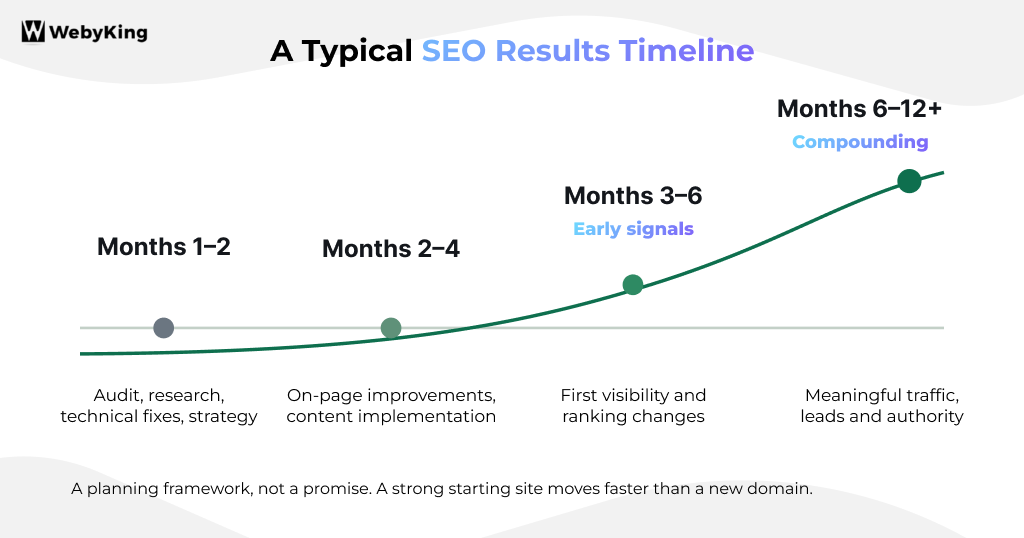
Treat this as a guide, not a promise. Some changes show up in hours, others take months. A strong site with existing authority moves faster than a brand-new domain in a tough market.
Is SEO Worth the Cost?
SEO is worth it when the searches you target connect to real business value. Ranking for a high-intent service keyword is worth more than thousands of visitors who never buy.
Before you decide, do the math: expected traffic, times your conversion rate, times your customer value. Then weigh that against your SEO cost.
Our guide on how to calculate SEO ROI walks through this step-by-step. And if you’re weighing SEO against paid ads, our SEO vs. PPC comparison breaks down the trade-offs. The point is to treat SEO as a growth channel, not just a ranking exercise.
SEO Cost Calculator: Get Your Personalized Budget Estimate
Every business’s SEO cost depends on competition, site size, and scope of work. Use this SEO cost calculator to answer a few quick questions and see where your business likely falls — then talk to us if you want a real scope built around it.
SEO Cost Estimator
itemized · directional · 2026
01 — Business size
Startup
Small
Medium
Large
Enterprise
02 — Target market
Local
Regional
National
Int'l
03 — Industry competition
Low
Medium
High
04 — Content production
Not needed
Needed
Technical & on-page SEO
Geographic scope
Competitive positioning
Content production
Reporting & strategy
Est. total
$500
up to $1,200 / month
Not a quote
This is a directional estimate built from 2026 industry pricing
benchmarks, not a formal proposal. Actual pricing depends on your
site's condition, goals, and the provider's scope.
How WebyKing Approaches SEO Pricing
Most of the ranges in this guide describe the market. Here’s how that becomes an actual engagement with WebyKing.
Every proposal starts with a scope conversation, not a fixed package pulled off a shelf. Your site’s technical condition, your competitors, and your goals decide what the engagement needs, rather than the other way around. That scope is laid out in our SEO packages, which break down what’s included at each budget level so you see the deliverables before you commit, not just a monthly number.
Our SEO work covers local, e-commerce, enterprise, and technical campaigns, along with industry-specific work for law firms, SaaS companies, and healthcare providers. The case studies show how that plays out for real clients.
Not Sure What You Should Be Paying?
Send us your current quote or scope, and we’ll tell you honestly if it matches the work — no upsell, no pressure.
Final Takeaway
SEO doesn’t have one standard price. For many small and midsize businesses, $1,000–$5,000 a month is a practical starting range. Local campaigns cost less. Competitive and enterprise campaigns cost more.
But the number is only part of the decision. Before you choose a provider, ask what you’re paying for, what will change on your site, how success is measured, who does the work, and whether the scope matches your competition.
The best SEO investment isn’t the cheapest or the most expensive. It’s the one that gives your business enough quality work to compete for valuable searches.
Looking for an SEO partner focused on growth, not just rankings? Explore WebyKing’s SEO services, or get in touch to see what a strategy-led engagement would look like for your business.
Frequently Asked Questions
How much does SEO cost per month?
Most small and midsize businesses plan for $1,000–$5,000 a month. Local campaigns can start lower, and enterprise campaigns can pass $10,000.
Is $500 a month enough for SEO?
It can work for a small local campaign, but keep the scope narrow. Don’t expect deep technical work, heavy content, and authority building at this level.
How much does local SEO cost?
Around $500–$2,000+ a month, depending on competition, locations, and how much ongoing work you need.
How much does e-commerce SEO cost?
Usually more, because of catalog size and technical complexity. A common range is $2,000–$10,000+ a month, and large stores can need more.
Is SEO a one-time cost?
Usually not. An audit can be one-time, but ongoing SEO is ongoing, because competitors and search results keep changing.
Why is SEO expensive?
It takes several skills: technical SEO, content, analytics, development, and authority building. The price reflects the people, tools, and time involved.
Agency or in-house: which is cheaper?
It depends. In-house gives you dedicated ownership. An agency gives you many specialists without building a department. Compare total capability, not just salary.
Can I do SEO myself?
Yes, smaller sites can handle the basics if the owner has time to learn. The trade-off is the time it takes to do it well.
Do I have to pay extra for GEO or AEO?
Usually not as a separate line. Optimizing for AI answers relies on the same foundations as good SEO. Be cautious of anyone charging a big premium just for the label. What can add cost is AI-visibility tools and more authority work.
How do I know if my SEO is working in AI search?
Regular rank trackers can’t see inside AI answers. Tools like Ahrefs Brand Radar, Otterly.ai, Profound, and Rankscale track whether AI tools mention your brand. Ask a provider how they measure it.
What should an SEO proposal include?
A clear scope, priorities, deliverables, reporting, responsibilities, access, contract terms, and realistic expectations.
I'm Ravi Makhija, Founder & CEO of WebyKing. I believe your website should be the hardest-working member of your team, building trust, generating leads, and creating opportunities 24/7. Through web design, development, SEO, and digital strategy, I help businesses build websites that become growth assets-not just digital brochures. Too many businesses invest in websites that look great but fail to deliver real business value.
Business owners deserve digital solutions that are simple, practical, and built around their goals, not unnecessary complexity. After all, your website shouldn't just represent your business; it should help grow it.

Need Help Understanding or Planning Your SEO Budget?