eCommerce SEO Trends 2026: Strategy for Online Stores

eCommerce SEO Trends to Watch in 2026 (Strategic Guide for Online Stores)
eCommerce SEO Trends Featured Image

eCommerce SEO in 2026 is no longer just about ranking product or category pages. Search visibility now depends on how well online stores perform across AI-driven results, zero-click SERPs, visual discovery, voice search, and multi-platform shopping journeys—all while meeting rising expectations around speed, relevance, experience, and trust.

At its core, modern eCommerce SEO focuses on making online stores visible when users search to buy, compare, or research products. As search engines increasingly rely on artificial intelligence to interpret intent and recommend trusted brands, traditional keyword-focused tactics are losing effectiveness. In their place, intent-driven and experience-led optimization is becoming central to long-term eCommerce search optimization success, building on core eCommerce SEO best practices that still define sustainable visibility.

It will break down the most important eCommerce SEO trends for 2026, explain why they matter, and outline how online stores can adapt strategically to remain competitive in an evolving search ecosystem.

This article is designed for eCommerce founders, marketing managers, SEO leads, and growth teams who want to understand how search visibility is evolving in 2026—and how to adapt strategically without relying on outdated, keyword-only tactics.

If you’re running a small to mid-sized online store, this guide helps you prioritize foundational changes that protect future visibility. If you manage a large or enterprise eCommerce site, it highlights advanced trends that influence scale, automation, and long-term authority.

14 Major eCommerce SEO Trends Defining 2026

1. AI-Powered Search Optimization (Core Trend)

Because AI systems interpret intent and context rather than exact keywords, eCommerce content that clearly solves buyer problems gains a ranking advantage.

AI-powered search optimization focuses on aligning eCommerce content with buyer intent, context, and usefulness rather than exact keyword matching.

Search engines now prioritize intent understanding, contextual relevance, and helpfulness over traditional keyword signals.

What this means for eCommerce websites

  • Content must clearly answer real buyer questions
  • Pages should support comparison and decision-making
  • Topical authority matters more than isolated page optimization

How to adapt

  • Structure content around customer problems and buying stages
  • Use clear headings, summaries, and FAQs
  • Build topic clusters instead of one-off pages

When AI can confidently understand who your page is for and what decision it supports, visibility improves, making this one of the most critical eCommerce SEO trends in 2026.

2. AI Overviews, Zero-Click Searches & Citation-Ready Content

Because AI-generated results summarize and cite trusted sources, eCommerce content must be structured to be easily interpreted and referenced.

AI Overviews and featured results reward content that is structured, authoritative, and easy for bots to summarize and cite.

Featured snippets, zero-click results, and AI Overviews now function as one connected ecosystem.

Why this matters

  • Users often get answers before clicking
  • AI systems cite only well-structured, trusted sources
  • Visibility builds brand authority even without immediate traffic

Optimization tactics

  • Definition-style introductions
  • Bullet-point answers
  • Question–answer formatting
  • Structured data where applicable

Rather than reducing SEO value, zero-click visibility strengthens brand trust across the buyer journey.

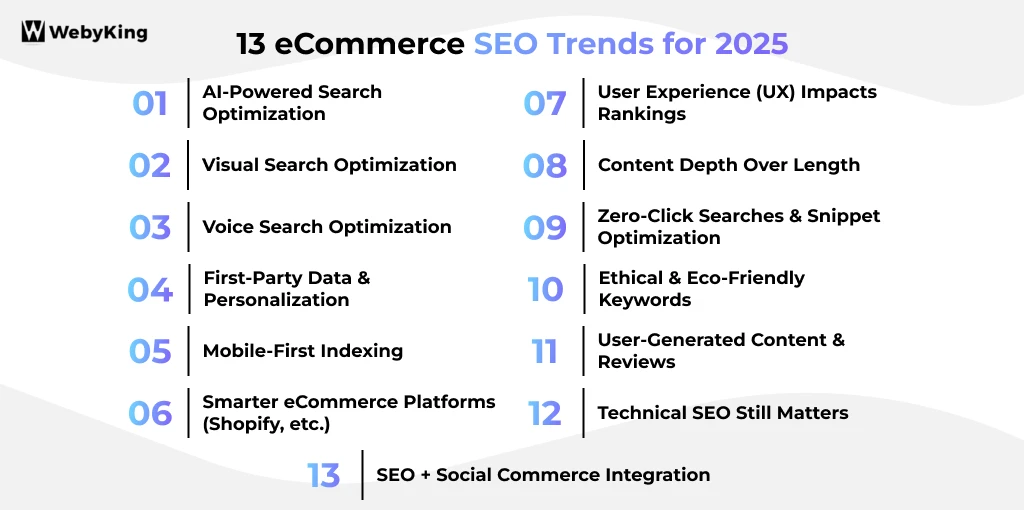
13 eCommerce SEO Trends for 2025

3. Entity-Based SEO & Brand Authority Signals

Entity-based SEO helps search engines recognize your business as a trusted, real-world brand, not just a collection of web pages.

Search engines increasingly evaluate eCommerce brands as entities.

Signals that strengthen entity recognition

  • Consistent brand messaging across the site
  • Clear About, Contact, and policy pages
  • Organization, Product, and Review schema
  • Mentions across trusted platforms

Strong entity signals improve AI visibility, trust, and long-term rankings—core components of a sustainable eCommerce SEO strategy.

4. Visual Search Optimization

Visual search allows users to find products using images instead of text, particularly on mobile devices.

As image-based discovery grows, visual optimization becomes a competitive visibility channel.

How to optimize

  • Descriptive image filenames
  • Helpful, context-rich alt text
  • Product-focused image schema
  • Relevant image placement within page content

Visual optimization expands reach beyond traditional keyword-based eCommerce search trends.

5. Voice & Conversational Search Optimization

Voice search optimization targets longer, more natural, and often transactional queries.

Voice queries reflect how people actually speak when searching.

Examples

  • “Best laptop for graphic design under $1,000”
  • “Where can I buy organic skincare near me?”

Best practices

  • Conversational FAQs
  • Natural language in product and category descriptions
  • Location, availability, and delivery context

Voice optimization supports both local visibility and intent-driven eCommerce SEO marketing.

6. Mobile-First Performance & Core Web Vitals

Mobile-first performance determines whether eCommerce pages are eligible to rank at all.

Google primarily evaluates the mobile experience when ranking eCommerce pages.

Key priorities

  • Fast load times
  • Visual stability
  • Touch-friendly design
  • Minimal intrusive elements

Poor mobile UX negatively impacts rankings, engagement, and revenue.

7. First-Party Data & On-Site Search Optimization

First-party data helps eCommerce brands improve relevance, structure, and internal discoverability.

With third-party tracking declining, first-party data plays a growing role in modern eCommerce SEO patterns.

Use this data to

  • Identify content and product demand gaps
  • Improve category and navigation structures
  • Optimize internal search results
  • Reduce bounce rates and pogo-sticking

Better relevance signals lead to stronger engagement and improved SEO performance.

8. Search Experience Optimization SXO (SEO + UX + CRO)

SXO focuses on turning search visibility into meaningful user satisfaction and conversions.

SEO success increasingly depends on how users interact with your store after they arrive.

SXO focuses on

  • Navigation clarity
  • Product filtering and faceted search
  • Internal search usability
  • Checkout simplicity

Search engines increasingly reward experiences that satisfy users—not just pages that rank.

9. Smarter eCommerce Platforms (But SEO Isn’t Automatic)

Modern eCommerce platforms support SEO foundations, but strategic optimization is still required.

Platforms like Shopify and BigCommerce provide stronger SEO defaults, but they do not replace expert optimization.

Advanced SEO still requires

  • Custom URL structures
  • Strategic internal linking
  • Enhanced structured data
  • Performance tuning

Platforms enable SEO, but they do not automate competitive advantage.

10. Programmatic eCommerce SEO for Scalable Growth

When product catalogs grow beyond manual optimization, programmatic SEO enables scalable visibility without sacrificing relevance.

Programmatic SEO enables large eCommerce sites to scale search visibility without manual page-by-page optimization.

This approach is especially valuable for stores with extensive catalogs and multiple product attributes.

Programmatic SEO enables

  • Long-tail category pages
  • Attribute-based landing pages
  • Automated template optimization

When implemented carefully, programmatic SEO expands coverage while maintaining quality and search intent alignment.

11. User-Generated Content & Social Proof

User-generated content strengthens trust, relevance, and long-tail keyword coverage.

Authentic user signals influence both buyers and search engines.

High-impact formats

  • Customer reviews
  • Product Q&A sections
  • User-submitted images and videos

Search engines increasingly view authentic user signals as indicators of credibility.

12. Trust-Based SEO Signals (E-E-A-T for eCommerce)

Trust determines whether eCommerce brands appear prominently in AI-driven SERPs.

As AI systems prioritize safety and credibility, trust signals play a larger ranking role.

Essential trust signals

  • Transparent policies
  • Verifiable business information
  • Secure checkout experiences
  • Expert-backed content

Low-trust eCommerce stores struggle to earn prominent visibility.

13. Technical SEO as Ranking Eligibility

Technical SEO defines whether eCommerce sites can be crawled, understood, and ranked.

It acts as the foundation for all other eCommerce SEO trends, making technical SEO for eCommerce stores essential for crawlability, indexing, and ranking eligibility.

Core essentials

  • Clean site architecture
  • Canonical and indexing controls
  • Structured data implementation
  • Server stability and performance optimization

Without strong technical foundations, other eCommerce SEO efforts underperform.

14. Multi-Platform Search Visibility (SEO + Social + Marketplaces)

eCommerce discovery now spans multiple platforms, not just Google.

Search journeys often begin and end across different ecosystems.

Visibility now includes

  • Organic search
  • Social commerce platforms
  • Marketplaces such as Amazon and Etsy

Unified optimization ensures consistent discovery across channels.

Strategic Outlook on eCommerce SEO Trends for 2026 and Beyond

The future of eCommerce SEO belongs to brands that:

  • Prioritize users over algorithms
  • Structure content for AI understanding
  • Invest in trust, experience, and authority
  • Adapt early to evolving search behavior

SEO is no longer just a traffic channel; it is a competitive advantage across the entire digital buying journey.

How Online Stores Can Prepare for These Trends

Not every eCommerce brand needs to act on every trend immediately. Priority depends on store size, technical maturity, and growth stage, which often determines whether teams hire an eCommerce SEO expert or manage SEO in-house.

Foundational priorities for most stores

  • Audit technical and mobile performance regularly
  • Strengthen content structure for AI Overviews and AEO
  • Improve trust signals and entity clarity

Advanced priorities for scaling eCommerce brands

  • Programmatic SEO implementation
  • First-party data utilization
  • Multi-platform search visibility alignment

Strategic prioritization prevents over-optimization while improving long-term visibility.

Final Thoughts

The eCommerce SEO landscape in 2026 is shaped by AI-driven discovery, changing search behavior, and rising expectations around trust and experience. Success is no longer achieved through isolated tactics; it requires a connected strategy that aligns technical foundations, content quality, brand authority, and user experience.

For online stores, this means shifting from short-term keyword wins to sustained visibility across AI Overviews, zero-click SERPs, visual search, voice queries, and multi-platform discovery paths. Brands that adapt early to these eCommerce SEO trends build compounding advantages, while those relying on outdated approaches risk gradual visibility loss.

Ultimately, eCommerce SEO is no longer just a marketing activity; it is a core growth system that influences how customers discover, evaluate, and choose your brand. Many online stores work with an experienced eCommerce SEO agency to implement these strategies effectively and maintain a competitive advantage.

FAQs on eCommerce SEO Trends

AI-powered search optimization, entity-based SEO, mobile-first performance, SXO, and trust signals are the most impactful eCommerce SEO trends for 2026.

AI shifts SEO from keyword targeting to intent fulfillment, rewarding clear, helpful, and authoritative content that answers real user questions.

Not necessarily. Zero-click visibility builds brand authority and trust, which can influence conversions later in the customer journey.

Digitizing Your Business Growth

We don’t just build websites; we craft digital experiences that drive results. Contact us today, and let’s turn your online presence into a powerful marketing tool that grows your business.

Start A Conversation With Us

WebyKing is a top-rated digital agency that helps you speed up your business growth to achieve maximum ROI.

Our Presence

Expand your business digitally on a global scale! We’re always ready at your service, with dedicated teams in three key international locations.

5354 Denny Ave, North Hollywood, Los Angeles, CA 91601, United States.

9720 Jones Rd, S210, Houston, TX 77065, United States.

The Spire, Office No: 312, Near Ayodhya Chowk BRTS Bus Stop, 150 Feet Ring Road, Rajkot