Last Updated: August 20, 2026
Reading Time: 16 minutes
Post Views: 1,815
- Website Design Cost by Service Provider
- Why Do Website Design Prices Vary So Much?
- Website Design Cost Breakdown: What Each Budget Gets You
- Custom Website Design Cost: Is It Worth the Extra Investment?
- Website Design Cost by Business Type (What Your Website Will Actually Cost)
- What Factors Affect Website Design Costs?
- Website Design Cost using AI website design platform
- Website Cost by Platform
- Who Should Build Your Website? A Cost Comparison
- Website Design Cost Based on Designer Location
- What Most Website Cost Guides Don’t Tell You
- Real Website Design Cost Examples
- What Are the Common Ongoing Website Costs?
- How to Save Money on Web Design Without Losing Quality?
- What Is the ROI of Investing in a High-Quality Website?
- Quick Comparison of a Cheap Website vs. a Professional Website
- Common Mistakes to Avoid When Budgeting for a Website
- What Should You Prepare Before Asking for a Website Quote?
- How Much Does a Website Redesign Cost?
- Which Budget Fits Your Project?
- Key Takeaways: Website Design Cost
- Final Thoughts
- Frequently Asked Questions (FAQs) on Website Design Cost
Average Cost of Website Design (2026)
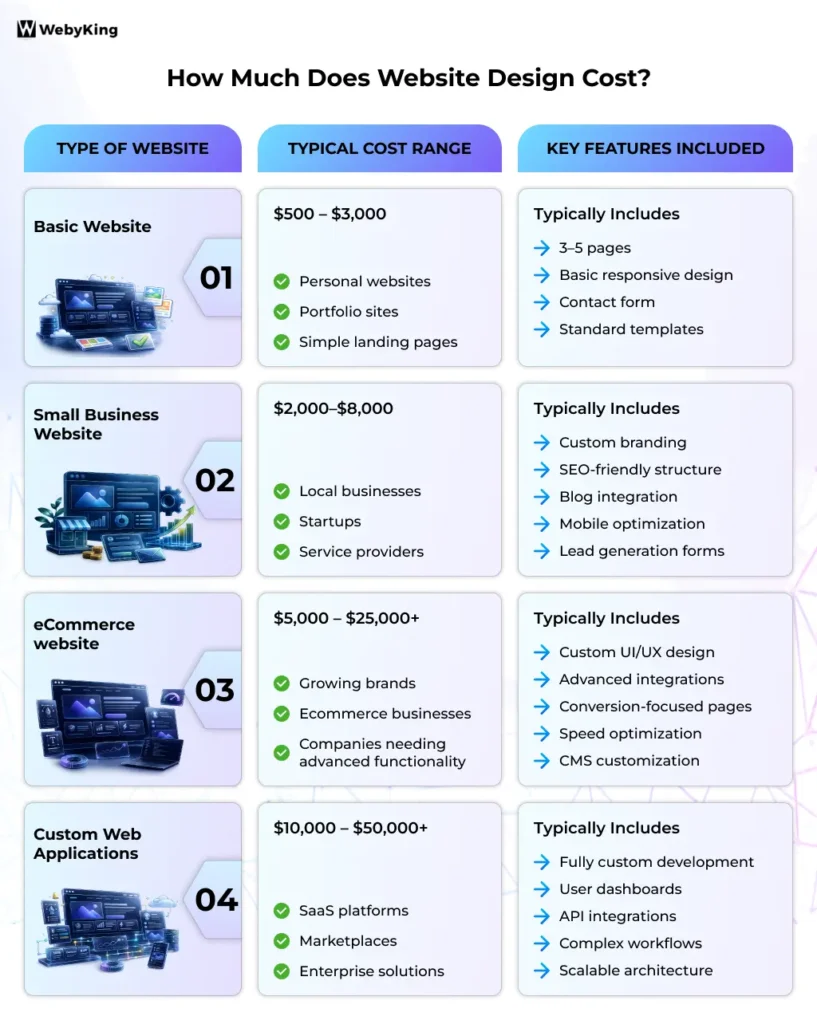
Website design costs range from $500 for a basic website to $50,000+ for complex custom platforms. Most small and mid-sized businesses invest around $3,000–$12,000 for a professional website, depending on the design, features, platform, and provider.
Here’s a quick overview of typical average website design cost ranges in 2026 based on common project types and business spending patterns:
- Basic Website (3–5 pages) – $500–$1,500
- Small Business Website (Lead generation & local businesses) – $2,000–$8,000
- Startup Website (Branding & early growth) – $3,000–$12,000
- eCommerce Website (Online store with payment functionality) – $5,000–$25,000+
- Custom Web Application (Advanced features & integrations) – $10,000–$50,000+
In practice, most small to mid-sized businesses tend to invest between $3,000 and $12,000, depending on their goals, required features, and long-term scalability needs.
Not sure which category fits your project? Keep reading—we’ll help you estimate the right budget based on your business type, website goals, and required features.
Why Trust These Cost Estimates?
The pricing ranges in this guide combine industry benchmarks, publicly available pricing data, and real-world website projects delivered by WebyKing. Actual costs vary by project scope, functionality, integrations, design requirements, and provider.
Most businesses don’t overpay for a website because prices are high — they overpay because they don’t fully understand what they actually need.
If you’ve ever wondered why one provider quotes $1,000 while another quotes $15,000 for what seems like a similar website, the difference usually comes down to design quality, functionality, scalability, and long-term performance.
A low-cost website that fails to generate leads or conversions can cost more over time than investing in a well-designed site from the start.
Research from Stanford’s Web Credibility Project highlights website design as an important factor in users’ perceptions of a website’s credibility.
Website Design Cost by Service Provider
Different approaches to building a website come with different cost expectations:
| Approach | Cost Range | Best For |
| DIY Website | $0 – $500 | Personal or very small websites |
| Freelancers | $500 – $5,000 | Small business websites |
| Agencies | $3,000 – $25,000 | Professional and scalable sites |
| Custom Dev | $10,000+ | Complex or enterprise platforms |
Why Do Website Design Prices Vary So Much?
Two providers can quote very different prices for what appears to be the same website because the scope of work may be completely different.
For example, a freelancer may deliver a basic website with a template and a few standard pages, while an agency may include business strategy, custom UI/UX design, SEO planning, responsive development, performance optimization, third-party integrations, quality assurance testing, training, and post-launch support.
When comparing website quotes, you’re not just paying for the final design—you’re paying for everything required to plan, build, launch, and support a website that meets your business goals.
Website design pricing commonly includes:
- Discovery and project planning
- Wireframing and user experience (UX) design
- Website design and development
- Mobile responsiveness
- Basic SEO setup and site structure
- Performance optimization
- Third-party integrations
- Testing and quality assurance
- Launch and post-launch support
The final price is usually influenced by several key factors:
- Custom design vs. template-based design
- Basic pages vs. advanced functionality
- SEO-ready structure vs. standard setup
- Limited revisions vs. ongoing support
- Performance optimization vs. basic development
- Scalable architecture vs. short-term solutions
Because every provider offers a different scope of work, two proposals with similar prices may still deliver very different results.
When comparing website quotes, focus on what’s included, not just the total price. A detailed scope of work will tell you far more about the value you’re receiving than the number at the bottom of the proposal.
Website Design Cost Breakdown: What Each Budget Gets You
The budget required for a website depends largely on its type, functionality, design requirements, and business goals. The ranges below provide general benchmarks for 2026.
Basic Website ($500–$1,500)
Ideal for personal websites, portfolios, simple landing pages, brochure-style websites or very small businesses that need a simple online presence.
Typically includes:
- 3–5 pages
- Template-based design
- Mobile-responsive layout
- Contact form
- Basic content setup
Standard Business Website ($1,500–$5,000)
Designed for blog websites and small businesses that need a clean, professional website with essential features, mobile responsiveness, and a foundation for future growth.
Typically includes:
- Custom branding and design
- SEO-friendly website structure
- Blog or CMS integration
- Mobile optimization
- Lead generation forms
- Basic third-party integrations
Advanced Business Website ($5,000–$15,000+)
Suitable for growing businesses that require more customization, advanced functionality, and conversion-focused design.
Typically includes:
- Custom UI/UX design
- Advanced integrations
- Conversion-focused landing pages
- Performance optimization
- CMS customization
- Enhanced user experience features
Custom Web Applications ($10,000–$50,000+)
Built for businesses requiring unique functionality, custom workflows, or scalable digital platforms.
Typically includes:
- Fully custom development
- User dashboards and portals
- API integrations
- Complex workflows
- Advanced security requirements
- Scalable architecture
If you’re a small or growing business, the Standard Business Website and Advanced Business Website tiers above are most relevant to your immediate needs.
Here are some typical website scenarios and what they usually cost:
- 5–10 page service website → $2,000 – $5,000
- Lead-generation website with SEO → $5,000 – $8,000
- eCommerce store (up to 50 products) → $6,000 – $12,000
- Custom website with integrations → $10,000+
Note: These are general industry benchmarks. Actual pricing varies based on project requirements, custom functionality, integrations, and the service provider you choose.
eCommerce websites generally require higher investment due to payment integrations, product management, and scalability needs. You can explore a detailed breakdown of eCommerce website costs to understand these requirements better.
Custom Website Design Cost: Is It Worth the Extra Investment?
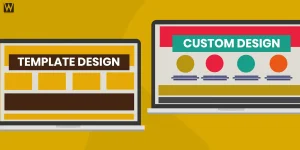
Custom web design typically costs $5,000–$25,000+ depending on complexity. Unlike template-based builds, custom design gives you full control over branding, UX, and functionality. For businesses with clear lead-generation or growth goals, a custom website can provide greater control over branding, user experience, functionality, and conversion optimization. The return depends on traffic, marketing, conversion performance, and ongoing optimization.
Website Design Cost by Business Type (What Your Website Will Actually Cost)
Not all websites cost the same, and more importantly, not every business needs the same type of website.
The real question is not:
“How much does a website cost?”
It’s:
“What will my website cost based on my business and goals?”
Use the breakdown below to identify where you fit quickly and what you should realistically expect to invest.
Small Business Website (Service-Based Businesses)
Typical Cost: $2,000 – $8,000
Best for:
Local businesses, consultants, agencies, service providers
What you usually need:
- 5–10 pages (Home, About, Services, Contact)
- Mobile-responsive design
- Contact forms & lead capture
- Basic SEO setup
- Trust elements (reviews, testimonials)
What affects your cost:
- Number of services/pages
- Content creation (done-for-you vs self)
- Design customization
- SEO depth
How to decide:
- If you just need an online presence → stay closer to $2K–$4K
- If you want consistent leads → invest $5K–$8K
Startup Website (Growth-Focused)
Typical Cost: $3,000 – $12,000
Best for:
Startups, SaaS, new ventures planning to scale
What you usually need:
- Strong branding & modern UI
- Conversion-focused landing pages
- Product or service positioning
- Marketing integrations (CRM, email tools)
- Scalable structure
What affects your cost:
- Branding complexity
- Funnel/landing page strategy
- Integrations (CRM, analytics, automation)
- Future scalability planning
How to decide:
- If you’re validating an idea → keep it lean ($3K–$6K)
- If you’re preparing to scale or pitch → invest $7K–$12K
eCommerce Website
Typical Cost: $5,000 – $25,000+
Best for:
Online stores, D2C brands, product-based businesses
What you usually need:
- Product catalog (10–1000+ products)
- Payment gateway integration
- Cart & checkout optimization
- Customer accounts
- Conversion-focused UX
What affects your cost:
- Number of products
- Custom features (filters, subscriptions, bundles)
- Platform (Shopify, WooCommerce, custom)
- Integrations (inventory, shipping, CRM)
How to decide:
- Small store (under 50 products) → $5K–$10K
- Growing brand (100+ products, marketing focus) → $10K–$20K
- Advanced store (custom features, scaling) → $20K+
Growing / Established Business Website
Typical Cost: $5,000 – $15,000+
Best for:
Businesses with 5–50+ employees, scaling operations
What you usually need:
- Conversion-focused design
- SEO-ready structure
- Landing pages for campaigns
- CRM and tool integrations
- Performance optimization
What affects your cost:
- Marketing requirements
- SEO depth
- Number of landing pages
- Integration complexity
How to decide:
- If your website is mainly an online brochure → a simpler budget may be enough.
- If you want it to generate leads consistently → $8K–$15K can be a more realistic investment.
Enterprise / Corporate Website
Typical Cost: $15,000 – $50,000+
Best for:
Large organizations, enterprise systems, complex operations
What you usually need:
- Custom workflows & dashboards
- Advanced integrations (ERP, CRM, APIs)
- High-level security
- Multi-language support
- Scalable infrastructure
What affects your cost:
- Custom functionality
- Security requirements
- System integrations
- Team collaboration needs
How to decide:
- If your website supports operations (not just marketing) → expect higher investment
- If scalability, performance, security, or integrations are critical → you may need a more customized architecture.
Ask yourself:
- Do I need leads or just presence?
- Will my website grow with my business?
- Do I need advanced features or just basics?
Simple Rule:
- Basic needs → lower budget
- Growth-focused → mid investment
- Revenue-driving platform → higher investment
What Most Businesses Get Wrong
Many businesses choose based on price alone.
But the better approach is:
Choose based on what your website needs to do for your business
Because:
- A $3,000 website that generates leads = profitable
- A $1,000 website that does nothing = expensive mistake
Want a Clear Cost for Your Specific Project?
Every website is different, and your exact cost depends on your goals, features, and growth plans.
Get a tailored estimate based on your requirements (not generic ranges).
What Factors Affect Website Design Costs?
Website cost depends on several factors beyond visual design alone. The required functionality, integrations, customization level, and development effort all influence the final project cost.
In most projects, custom functionality, eCommerce features, booking systems, third-party integrations, and advanced user experiences have the biggest impact on overall website costs.
Key Factors That Affect Website Cost
| Factor | Impact on Cost |
| Custom Design | High |
| Features & Integrations | Very High |
| Number of Pages | Medium |
| Hosting/Domain | Low |
Additional Features That Increase Website Costs
- Custom Design: +$1,000–$3,000
- CMS Setup (WordPress): +$300–$800
- eCommerce Features: +$2,000–$10,000
- SEO Setup: +$500–$2,000
- Extra Pages (5–10): +$500–$1,00
Search engine optimization is another important factor that can influence long-term website performance. Reviewing typical SEO pricing can help in planning a more realistic budget.
Some platforms are faster and cheaper to launch with, while others offer greater flexibility and scalability.
Website Design Cost using AI website design platform
AI website builders offer a lower-cost alternative to traditional website design through free or subscription-based plans. In 2026, costs range from free to $50+ per month, depending on the platform, features, billing period, ecommerce requirements, and level of support.
However, the builder subscription is not the same as professional website design. The subscription covers access to the platform and its tools, while professional strategy, customization, SEO, content, integrations, and development can involve additional costs.
| AI Website Builder Plan | Typical Cost | Common Features |
| Free | $0/month | Basic AI tools, templates, and website creation |
| Standard | $10–$30/month | Hosting, custom domain, AI tools, and business features |
| Advanced | $30–$50+/month | Ecommerce, higher limits, and advanced features |
Examples of AI Website Platforms
- Wix AI Website Builder → AI-assisted website creation with visual editing and business features
- Durable → Fast AI-generated websites for small businesses
- 10Web → AI-powered WordPress website creation and hosting
- Jimdo → AI-assisted website creation for small businesses and personal websites
- Framer AI → AI-powered website builder with modern design and fast visual editing
- Olitt → AI website creation with hosting and business features
Pricing varies by platform, country, billing period, and promotional offers. Businesses should compare total annual costs and renewal pricing rather than focusing only on the advertised monthly price.
Final Cost Perspective
AI website builders can significantly reduce the upfront cost and time required to launch a website, particularly for businesses using the platform themselves. However, professional customization, advanced functionality, SEO, integrations, and ongoing development can increase the total project cost.
For businesses that require professional customization, advanced functionality, SEO, integrations, or ongoing development, the overall website investment can still be significantly higher than the AI builder subscription itself.
Website Cost by Platform
Platform costs and website design costs are not always the same. Some platforms charge a monthly subscription, while the cost of a professionally designed website depends on the work required to customize, build, and launch it.
| Platform | Cost Model | Best For |
| WordPress | Hosting + development | Flexible business websites |
| Wix / Squarespace | Monthly subscription + optional professional setup | DIY and simple business websites |
| Webflow | Subscription + design/development | Design-focused websites |
| Shopify | Monthly subscription + store setup/development | eCommerce |
| Custom Development | Project-based | Complex functionality |
Each platform comes with different pricing models, maintenance requirements, and customization options, making platform selection an important budgeting decision.
If you're trying to estimate your website budget, it’s helpful to outline your required features, number of pages, and long-term goals before comparing different pricing options.
Who Should Build Your Website? A Cost Comparison
The cost of building a website depends heavily on who you hire or which approach you take. This is also why how much web designers charge can vary widely. Here’s how every option compares:
| Option | Cost Range | Pros | Cons | Best For |
| DIY Website | $0–$500 | Low cost, full control | Time-consuming, requires learning and maintenance | Personal sites, simple projects |
| Freelancer | $500–$5,000 | Affordable, flexible | Limited support, inconsistent quality | Small projects, brochure websites |
| Agency | $3,000–$20,000+ | Professional, SEO-ready, scalable | Higher upfront cost | Growing businesses |
| In-House Team | $85,000–$300,000+/year in staffing costs | Full control, always available | Very expensive, high overhead | Large enterprises |
1. DIY Website
Building a website yourself can be one of the most affordable options, especially for personal websites, portfolios, simple blogs, or very small businesses with straightforward requirements. Costs mainly depend on the platform, hosting, domain, templates, and other tools you choose.
- Typical Cost: $0–$500
- Best for: Personal projects, simple websites, early-stage ideas
- Cost Factors: Hosting, domain name, premium templates, plugins, and tools
This option gives you full control over your website, but it requires time, effort, and a willingness to learn. While upfront costs are low, ongoing maintenance and updates are your responsibility.
2. Freelance Website Designer
Freelancers are a cost-effective choice for small businesses and one-time projects. They offer flexibility in pricing and can deliver quality work depending on their experience and specialization.
- Typical Cost Range: $500–$5,000 per project
- Best for: Startups, small businesses, brochure websites
- Cost Factors: Experience level, location, project scope, and turnaround time
Freelancers typically charge between $15 and $150 per hour. While this option is budget-friendly, it may lack the structured process, scalability, and long-term support that growing businesses often need.
3. Professional Web Design Agency
Working with an agency gives you access to a full team of experts, including designers, developers, strategists, and project managers. This is ideal for businesses that need a high-quality, scalable, and performance-focused website.
- Typical Cost Range: $3,000–$20,000+ per project
- Best for: Growing businesses, custom websites, long-term scalability
- Cost Factors: Project complexity, custom design, integrations, SEO, and additional services
Agencies follow a structured approach and focus on both design and business outcomes. While the cost is higher, the result is usually more reliable, scalable, and aligned with long-term goals.
4. In-House Web Design Team
An in-house team is best suited for companies with continuous website, product, or digital needs. Instead of outsourcing, you build a dedicated team that works closely with your business.
- Typical Cost Range: $85,000–$300,000+ per year
- Best for: Enterprises, large-scale and ongoing projects
- Cost Factors: Salaries, employee benefits, tools, software, and operational overhead
This approach offers maximum control and alignment with your business, but it requires significant investment and is not practical for one-time website projects.
Each option comes with its own trade-offs between cost, control, and scalability. The right choice depends on your business stage, budget, and long-term goals—not just the upfront price.
Website Design Cost Based on Designer Location
Website design pricing can vary significantly based on where your designer, developer, or agency is located. While expertise and project requirements remain the biggest cost drivers, regional differences in labor costs and market rates often influence hourly pricing. The table below provides broad hourly benchmarks by region. Actual rates vary significantly based on experience, specialization, agency size, project complexity, and market.
Average Web Design Cost Per Hour (By Region & Currency)
| Region | Average Cost Per Hour |
| USA | $100 – $180 (USD) |
| UK | £60 – £110 (GBP) |
| Australia | A$120 – A$220 (AUD) |
| India | ₹1,200 – ₹3,300 (INR) |
| Western Europe | €55 – €110 (EUR) |
While lower rates can reduce upfront costs, it’s important to evaluate the full scope of work, communication, and long-term value rather than price alone.
What Most Website Cost Guides Don’t Tell You
Many pricing guides focus only on upfront costs, but long-term expenses and performance impact are often overlooked.
For example:
- A cheaper website may require a full redesign within 1–2 years
- Poor SEO structure can limit organic traffic growth
- Low-quality development can increase maintenance costs over time
A low-cost website can become more expensive over time if it requires frequent fixes, poor performance limits growth, or an early redesign.
Understanding total cost of ownership — not just the build cost — is what separates smart website investments from expensive mistakes.
Real Website Design Cost Examples
The examples below are based on real client projects delivered by WebyKing and illustrate how website requirements, functionality, and business goals can influence project investment and outcomes.
To better understand how website costs translate into real-world outcomes, here are a few typical project scenarios based on common business requirements:
Example 1: Small Business Website (Barking Trails - Pet Care Services)
Barking Trails, a US-based pet care service offering dog walking, pet sitting, and in-home boarding, needed a website that could establish their online presence and streamline bookings. WebyKing built a custom WordPress site with interactive service listings, a seamless booking system, and contact forms — with a project investment in the $3,000–$6,000 range.
After launch, Barking Trails saw a 10x increase in lead generation, 55% growth in monthly organic traffic, 125% increase in new users, and a 78% improvement in conversion rate.
Example 2: Professional Services Website (People Development Australia - Coaching & Training)
People Development Australia, a soft skills consultancy offering leadership coaching and team development programs, needed a structured, content-rich website to showcase their courses and attract new clients. WebyKing built a custom WordPress site with a course catalog, resource library, secure login, and blog integration — typically in the $5,000–$10,000 range for projects of this scope.
Post-launch results included a 117% increase in traffic, 78% growth in new leads and inquiries, 57% improvement in engagement, and a 42% conversion rate improvement.
Example 3: eCommerce Website (Fika Nutrition - Health & Wellness)
Fika Nutrition, a health and wellness brand offering meal plans and diet education, partnered with WebyKing to expand its global digital presence. The project involved custom UI design, responsive development, and performance optimization on WordPress — with projects of this type typically ranging from $8,000–$15,000.
Within 6 months of launch, Fika Nutrition achieved 135% audience growth, a 68% increase in sales, a 45% increase in orders, a 43% growth in repeat orders, and a 97% customer satisfaction rate.
These are real projects WebyKing delivered. Results vary based on industry, traffic volume, and marketing strategy — but they reflect what’s possible when design decisions are aligned with clear business goals.
Working on a similar project? Get a free cost estimate tailored to your requirements.
What Are the Common Ongoing Website Costs?
Many businesses focus on the initial website design cost but overlook the ongoing expenses required to keep a website secure, updated, and performing effectively. While costs like domain registration, hosting, and SSL certificates are relatively inexpensive, they are recurring expenses that should be included when calculating the total cost of ownership.
Common ongoing website costs include:
- Domain name → $10–$20/year
- Hosting → $50–$200/year
- SSL certificate → Free–$100/year
- Maintenance & updates → $50–$200/month
- Content creation → $100–$500 per page
- Premium plugins/themes → $20–$200
- SEO & performance optimization → $200–$1,000+
- Future redesign → $1,000–$5,000
These costs vary depending on your website’s size, functionality, and long-term goals. Understanding these ongoing expenses helps create a more realistic website budget and reduces the risk of unexpected costs later.
How to Save Money on Web Design Without Losing Quality?
You can reduce website costs without sacrificing quality by focusing on what truly matters.
- Start small (build an MVP website)
Launch with only essential pages like Home, About, and Contact. Add advanced features later once your website starts generating traffic or leads. - Use templates instead of custom design
Premium templates can reduce design time significantly while still delivering a professional look. Custom design should only be used when branding or functionality requires it. - Provide your own content
Supplying your own text, images, or brand assets can save hundreds of dollars in copywriting and media production costs. - Compare quotes from multiple providers
Always get 2–3 quotes with a clear scope of work. This helps you understand market pricing and avoid overpaying for similar services.
If your website budget is limited, prioritize user experience, mobile responsiveness, SEO fundamentals, and lead-generation functionality before investing in advanced features or custom enhancements.
A website isn’t just an expense; it’s a growth tool. The real question isn’t “how much does it cost?” but “what does it return?”
What Is the ROI of Investing in a High-Quality Website?
A professionally designed website is more than an online presence — it directly impacts trust, conversions, visibility, and long-term business growth.
A high-quality website can help businesses:
- Improve trust and credibility
- Increase leads and conversions
- Support long-term SEO growth
- Create a better user experience
- Reduce future redesign costs
The real value of a website should be measured by business results, not just upfront pricing.
Research consistently shows that investing in UX improves conversion rates, reduces bounce rates, and increases customer trust — all of which directly impact revenue. For example, if a website receives 1,000 visitors per month and generates 10 additional qualified leads after improving its conversion experience, with each lead worth $200, that could represent $2,000 in potential monthly pipeline.
Low-cost websites may seem affordable initially, but they often lead to long-term issues, including poor SEO performance, limited scalability, slow loading times, and higher redesign costs.
Businesses lose customers when their websites look outdated, feel difficult to use, or create friction during the buying process.
Businesses that invest in usability, SEO structure, and scalability from the start typically avoid costly rebuilds within the first 2–3 years.
The cheapest website isn’t the one that costs the least—it’s the one that generates the highest return over time.
Quick Comparison of a Cheap Website vs. a Professional Website
A low-cost website may save money upfront, but many businesses later pay far more through redesigns, poor conversions, lost leads, and slow performance.
| Factor | Cheap Website | Professional Website |
| Cost | Low upfront ($300–$800) | Higher upfront ($3,000+) |
| Design Quality | Basic templates | Custom, branded design |
| SEO Performance | Weak | Optimized for search engines |
| Load Speed | Often less optimized | Performance-optimized |
| Conversion Potential | Limited optimization | Conversion-focused UX |
| Scalability | Limited | Built for growth |
| Long-Term Cost | Higher (due to redesigns) | Lower (future-proof) |
Common Mistakes to Avoid When Budgeting for a Website
Many businesses overspend on websites due to poor planning and unclear goals.
- Choosing the cheapest option without checking quality
- Ignoring mobile responsiveness
- Not planning for SEO
- Adding unnecessary features early
- Not defining clear business goals
Estimate Your Website Budget in 60 Seconds
Before requesting quotes, answer these five questions to get a clearer idea of what your website may cost:
- How many pages do you need?
- Will you sell products online?
- Do you need bookings, memberships, or user accounts?
- Will content and branding be provided or created from scratch?
- Are SEO, integrations, or custom functionality required?
The more “yes” answers you have, the higher your project cost is likely to be. The more complex your requirements, the more your project budget is likely to increase.
What Should You Prepare Before Asking for a Website Quote?
Getting accurate website pricing becomes much easier when you clearly define your project requirements upfront. In many projects, unclear expectations lead to inaccurate quotes, scope changes, and unexpected costs later.
Before requesting a quote, prepare:
- Estimated number of pages
- Required features (eCommerce, booking, login, etc.)
- Websites or designs you like
- Your business goals
- Content readiness (text, images, branding)
- SEO or marketing requirements
- Expected timeline and budget
If one quote is dramatically cheaper than the others, check what’s missing before assuming it’s the better deal.
The more clearly you define your needs, the easier it becomes to compare quotes and avoid unnecessary revisions later.
Many businesses also wonder whether a website quote is reasonable. Rather than comparing prices alone, review the scope of work, including features, SEO considerations, revisions, support, and scalability to ensure you’re comparing equivalent deliverables.
When reviewing a quote, watch for these red flags: no itemised scope of work, vague deliverables, no mention of post-launch support, and unusually low pricing with no explanation. A trustworthy quote should clearly list pages, features, revisions, timeline, and what happens after launch.
How Much Does a Website Redesign Cost?
Redesigning an existing website typically costs 60–80% of building a new one. Most small business redesigns fall between $2,000 and $10,000. Enterprise redesigns can exceed $25,000.
Key factors that drive redesign costs up: content migration, rebrand requirements, platform switching (e.g., moving from Wix to WordPress), and adding new functionality that didn’t exist before.
Signs you need a redesign:
- The site loads slowly
- Doesn’t rank in Google
- Has a poor mobile experience
- It isn’t generating leads despite traffic.
Which Budget Fits Your Project?
If you need… | Typical Budget |
| A personal website or portfolio | $500–$1,500 |
| A local business website | $2,000–$5,000 |
| A professional service website | $3,000–$8,000 |
| A startup website | $3,000–$12,000 |
| An online store | $5,000–$25,000+ |
| A custom web application | $10,000–$50,000+ |
Still unsure? The fastest way to estimate your budget is to list your required pages, features, and business goals. A detailed project brief will always produce a more accurate quote than general pricing ranges.
Key Takeaways: Website Design Cost
- Website costs range from $500 to $50,000+, based on complexity and features.
- You’re paying for strategy, UX, and scalability, not just design.
- Cheaper websites can cost more long-term due to poor performance.
- Scope matters more than price; deliverables vary between providers.
- $500-$1,500: Basic websites for simple needs.
- $1,500-$15,000+: Business-ready, SEO-friendly websites.
- $10,000-$50,000+: Custom solutions for scaling businesses.
- Ongoing costs (maintenance, SEO) are just as important as upfront cost.
- The right investment depends on your business goals and growth plans.
Final Thoughts
Understanding website design costs starts with identifying your business goals, required functionality, and long-term growth plans.
The best website investment is not necessarily the cheapest option—it’s the one that delivers measurable business value, supports future growth, and provides a strong user experience.
Before requesting quotes, take time to define your requirements, priorities, and budget. A clear project scope leads to more accurate pricing, better provider comparisons, and stronger long-term results.
Not sure how much your website will cost based on your requirements?
Tell us about your project, and we’ll provide a realistic budget range—based on your goals, required features, and long-term plans, not generic averages.
Frequently Asked Questions (FAQs) on Website Design Cost
How much does a website cost in 2026?
A website typically costs $500–$50,000+ in 2026. Basic websites may cost $500–$1,500, small business websites $2,000–$8,000, and custom web applications $10,000–$50,000+.
How much should a small business spend on a website?
A small business should typically budget $2,000–$8,000 for a professional website. The final cost depends on the number of pages, design requirements, SEO, integrations, and functionality.
How much does a professional website cost?
A professional website typically costs $3,000–$10,000, while complex eCommerce websites, custom functionality, and enterprise projects can cost $25,000–$50,000+.
How much does a 10-page website cost?
A professionally designed 10-page business website typically costs $3,000–$7,000. Custom design, content creation, SEO, integrations, and advanced functionality can increase the cost.
How much does a landing page cost?
A landing page typically costs $100–$1,000 for a template-based build and $1,500–$2,500+ for a custom, conversion-focused design. Copywriting, A/B testing, and custom functionality can increase the cost.
How much does a custom website cost?
A custom business website typically costs $5,000–$25,000, while complex custom platforms can cost $10,000–$50,000+. Custom UX design, integrations, workflows, and development complexity are major cost drivers.
How much does a website redesign cost?
A website redesign typically costs $2,000–$15,000 for small to mid-sized businesses. Platform migration, content migration, rebranding, new functionality, and the size of the redesign can increase the cost.
What factors affect website design costs?
The main factors affecting website design costs are design customization, number of pages, functionality, eCommerce requirements, integrations, SEO, content creation, platform choice, and ongoing support.
Do I need to pay monthly for a website?
Yes. Most websites have ongoing costs such as hosting, domain renewal, maintenance, security updates, premium plugins, and SEO or marketing services. These costs are separate from the initial website design fee.
Should I hire a freelancer or a web design agency?
A freelancer is usually better for smaller, straightforward projects, while a web design agency is better for businesses that need strategy, custom design, development, SEO, integrations, and ongoing support.
How much does an AI website builder cost?
An AI website builder typically costs $0–$50+ per month, depending on the platform, features, billing period, eCommerce requirements, and support. The subscription cost is separate from professional design or development services.
How long does it take to build a website?
A simple website typically takes 2–4 weeks, while larger business websites can take several weeks to several months. Custom functionality, integrations, content creation, revisions, and approval processes can extend the timeline.
I'm Ravi Makhija, Founder & CEO of WebyKing. I believe your website should be the hardest-working member of your team, building trust, generating leads, and creating opportunities 24/7. Through web design, development, SEO, and digital strategy, I help businesses build websites that become growth assets-not just digital brochures. Too many businesses invest in websites that look great but fail to deliver real business value.
Business owners deserve digital solutions that are simple, practical, and built around their goals, not unnecessary complexity. After all, your website shouldn't just represent your business; it should help grow it.



Need Help With Web Design?