Last Updated: June 11, 2026
Reading Time: 9 minutes
Post Views: 524
- Quick cost summary
- Which Path Fits Your Restaurant? (Simple decision guide)
- The Real Ongoing Costs (So There Are No Surprises)
- Restaurant Website Cost by Type of Restaurant
- What Actually Makes the Price Go Up or Down
- Your Own Website Ordering vs DoorDash / Uber Eats
- Best Platform for a Restaurant Website
- How Long Does It Take to Build a Restaurant Website?
- Does Cost Change by Location or Country?
- Already Have a Website? Signs It's Costing You Customers
- A Simple Pre-Build Checklist
- Questions To Ask Before You Hire Anyone
- Want a Quick Estimate?
- Final takeaway
- Frequently Asked Questions
If you run a restaurant and you’re trying to budget for a website, you don’t need a list of buzzwords. You need two answers: what will this realistically cost me, and which option is right for my place? This guide gives you both, with clear numbers, honest trade-offs, and a simple way to decide.
We build restaurant websites for a living, so we’ll also point out where owners tend to overpay, what’s safe to skip when money is tight, and what’s worth paying for because it actually brings in orders.
The short answer: A restaurant website can cost anywhere from about $150 a year (do-it-yourself) to $15,000 or more (a custom site from an agency). Most independent restaurants land somewhere in between. The rest of this guide explains why, and helps you find your number.
Quick cost summary
| Way to build it | Typical cost | Best for |
| DIY website builder (Wix, Squarespace) | $10–$50/month (~$150–$600/year) | New or very small places, tight budget, simple needs |
| Restaurant-specific platform (e.g. Owner, Popmenu, BentoBox) | ~$100–$500/month | Owners who want a website + online ordering in one tool |
| Freelancer (template-based build) | $500–$3,000 one-time | A custom look without agency prices |
| Web design agency (custom build) | $3,000–$15,000+ one-time | Multiple locations, custom ordering, brand-led design |
| Enterprise / fully custom ordering system | $25,000+ | Chains recapturing delivery margin |
These are planning ranges. Your real number depends on the features you need and who builds it. Here, answer some questions and get your customized budget for the website design according to your needs.
The 4 Ways to Build a Restaurant Website (and what each really costs)
Most cost confusion comes from comparing prices without comparing paths. There are really only four, and they’re very different.
1. Do it yourself with a website builder
Cost: $10–$50/month.
Time: A weekend.
You pick a template, drop in your menu and photos, and go live. Wix and Squarespace are the common choices.
- Good: cheapest, fastest, you control updates.
- Watch out for: restaurant features like online ordering or reservations often need add-ons; templates can look generic; and if something breaks during a Friday dinner rush, you’re on your own.
2. Use a restaurant-specific platform
Cost: ~$100–$500/month.
Time: Days.
These tools (Owner, Popmenu, BentoBox and similar) bundle your website, menu, online ordering, and sometimes reservations into one subscription.
- Good: Built for restaurants; ordering and menus are handled for you; often commission-free.
- Watch out for: Monthly cost adds up; you may not fully own the site; design is less flexible than custom.
3. Hire a freelancer
Cost: $500–$3,000 one-time.
Time: 2–4 weeks.
A freelancer builds you a custom-looking site, usually on WordPress with a theme.
- Good: More personality than a template; one-time cost; cheaper than an agency.
- Watch out for: Quality varies a lot; support after launch can disappear; make sure you own the domain and site.
4. Hire a web design agency
Cost: $3,000–$15,000+ one-time (more for big or custom-ordering projects).
Time: 4–10+ weeks.
An agency handles strategy, design, build, content, and launch as a team.
- Good: custom design, restaurant-specific features done properly, ongoing support, better performance and SEO.
- Watch out for: highest upfront cost; make sure pricing and timelines are in writing.
Which Path Fits Your Restaurant? (Simple decision guide)
Use this as a starting point, not a rule.
| If this sounds like you… | Start here |
|---|---|
| Brand new, very tight budget, just need a menu + hours + map | DIY builder |
| Want online ordering without paying delivery-app commissions | Restaurant-specific platform, or a custom site with your own ordering |
| Want a unique look but can’t spend agency money | Freelancer |
| Multiple locations, or you want the site to be a real sales channel | Agency (custom) |
| You value your time more than the savings | Platform or agency like WebyKing (so you’re not the one fixing it) |
A quick gut-check: If your website’s main job is to tell people you exist (menu, hours, location, phone), spend less. If its job is to make you money (orders, reservations, events, catering leads), it’s worth investing more on restaurant website, because it pays you back.
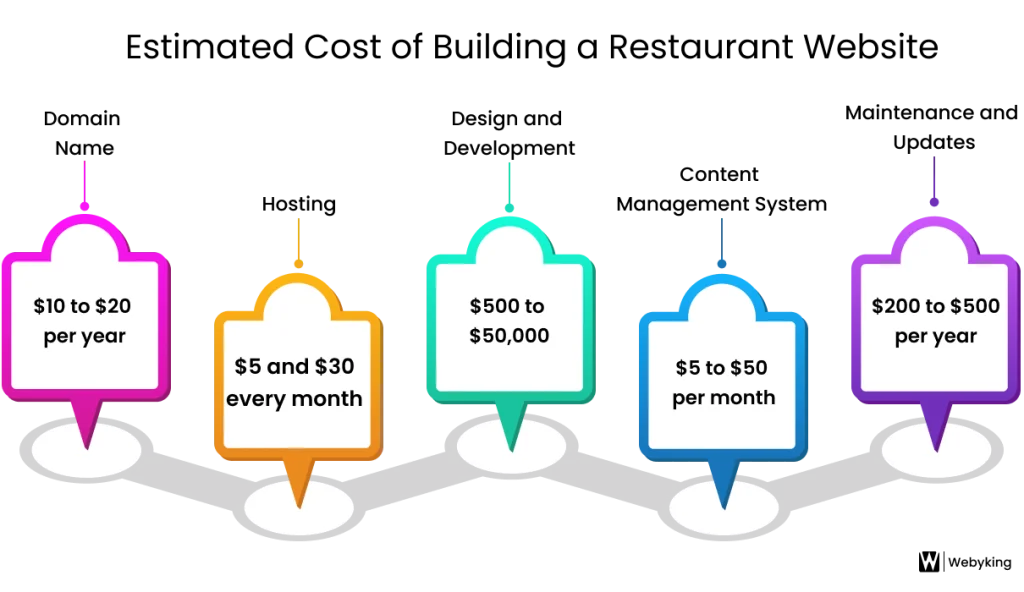
The Real Ongoing Costs (So There Are No Surprises)
A website isn’t just an upfront cost. Here’s the honest, all-in picture.
| Ongoing Item | Typical Cost | Notes |
|---|---|---|
| Domain Name | $10–$20/year | Your web address. Keep it in your account. |
| Hosting | $5–$50/month | Cheap hosting = slow site. Don’t go bargain-basement. |
| SSL Certificate (Security) | Often free–$200/year | A free certificate is fine for most restaurants. Required, as Google and browsers flag sites without it. |
| Maintenance & Updates | $50–$200/month, or 15–20% of build/year | Keeps your website secure, fast, and up to date. |
| Local SEO / Marketing | $0–$1,000/month (Optional) | Optional, but this is what helps customers find your restaurant online. |
Year-one example for a typical small restaurant (agency-built): Build $4,000 + hosting $300 + domain $15 + maintenance $1,200 ≈ ~$5,500 in year one, then ~$1,500–$2,000/year after that. A DIY site is far less; a multi-location site is far more.
Restaurant Website Cost by Type of Restaurant
Different restaurants need different things, so costs differ too. Rough guide:
| Restaurant Type | What It Usually Needs | Typical Sensible Budget |
|---|---|---|
| Cafe / Coffee Shop | Menu, hours, photos, maybe simple ordering | $500–$3,000 |
| Bakery | Menu/products, custom-order form, gallery | $800–$3,500 |
| Fast Food / QSR | Fast menu, online ordering, mobile-first | $2,000–$8,000 |
| Pizza Restaurant | Online ordering with item customization, deals | $2,500–$10,000 |
| Bar / Pub | Events calendar, menu, photos, bookings | $1,500–$6,000 |
| Ghost Kitchen / Delivery-Only | Strong ordering, multiple brands, no dine-in information | $3,000–$12,000 |
| Multi-Location / Chain | Location pages, central menu management | $8,000–$25,000+ |
| Franchise | Brand consistency, local pages, user permissions | $10,000–$30,000+ |
What Actually Makes the Price Go Up or Down
Instead of a generic feature list, here’s what each feature adds and whether it’s usually worth it.
- Online ordering (+$0–$3,000 depending on tool/build). Worth it if takeout/delivery is part of your business. A free or low-cost ordering tool added to a simple site is often enough to start.
- Reservations / bookings (+$0–$1,500). Worth it for sit-down and fine dining. Many tools have free tiers.
- Custom design vs template (+$1,000–$8,000). Worth it for brand-led places; skippable for a first website on a budget.
- Menu setup (often included). Make sure your menu is easy for you to update — you’ll change it often.
- SEO setup, especially local (+$0–$1,000 upfront). Worth it – most diners check your site before visiting, and local search is how nearby customers find you.
Where owners overpay: paying for a fully custom design before they have steady traffic, buying features they never use, and paying monthly for tools that overlap. Where owners underpay: photography and basic local SEO, the two things that actually bring people in.
Your Own Website Ordering vs DoorDash / Uber Eats
This is the question behind a lot of “should I spend on a website?” searches, so let’s do the math simply.
Third-party delivery apps are great for reach, but they typically take a large cut of each order (often around 15–30%). On high volume, that adds up fast.
- Example: if you do $20,000/month in delivery orders and pay 25% in commissions, that’s $5,000/month — $60,000 a year — going to the app.
- A custom site with its own ordering might cost $3,000–$10,000 once, plus a small monthly fee.
The point isn’t “drop the apps.” It’s that even shifting a fraction of your orders to your own site can pay for the whole website in a few months and after that, the savings are yours. Many owners use the apps for discovery and their own site for repeat customers.
Best Platform for a Restaurant Website
There’s no single “best”, it depends on what you want. Quick honest take:
| Platform | Cost | Best For | Trade-Off |
|---|---|---|---|
| Wix | ~$17–$49/mo | All-in-one ease; built-in restaurant tools | Less design freedom than custom websites |
| Squarespace | ~$16–$40/mo | Beautiful templates, design-led owners | Ordering and reservations often require add-ons such as Tock or ChowNow |
| WordPress | Hosting + Theme/Development Costs | Full control and ownership; grows with your business | Steeper learning curve and often requires professional support |
| Shopify | ~$39+/mo | Heavy online ordering and product sales | Designed primarily for eCommerce rather than dine-in restaurants |
| Restaurant-Specific Platforms (Owner, Popmenu, BentoBox) | ~$100–$500/mo | Website and ordering bundled together; commission-free ordering | Higher monthly costs and less ownership/control compared to custom websites |
Is Wix Good for Restaurants?
Yes, for a simple, affordable site you manage yourself, it has menu and ordering tools built in. If you want a one-of-a-kind design or you’re running multiple locations, a custom WordPress build will serve you better long-term.
How Long Does It Take to Build a Restaurant Website?
| Path | Typical Timeline |
|---|---|
| DIY Builder | A weekend to a week |
| Restaurant Platform | A few days (templates + your menu) |
| Freelancer | 2–4 weeks |
| Agency (Custom) | 4–10+ weeks, depending on features and content |
The biggest delay is almost always content, menu, photos, and text. If you have those ready, everything moves faster.
Does Cost Change by Location or Country?
Yes and not by a small amount. The same restaurant website can cost very differently depending on where it’s built, mostly because of local labour rates, what customers expect, and a few region-specific must-haves. Here’s a realistic 2026 picture for a professional restaurant website (menu, photos, mobile, and basic online ordering), built by a freelancer or small agency.
| Region | Typical Professional Restaurant Site | Roughly in USD | What’s Different Here |
|---|---|---|---|
| USA | $2,000 – $8,000 | — | High demand for online ordering and local SEO; custom agency builds typically cost more. |
| UK | £1,500 – £6,000 | ~$1,900 – $7,600 | Tighter price range; London costs more. Most agency prices exclude 20% VAT. |
| Australia | A$4,000 – $12,000 | ~$2,600 – $7,900 | Higher due to local labour and living costs; Sydney and Melbourne are typically 20–30% more expensive than smaller cities. |
| Middle East (UAE) | AED 7,000 – 25,000 (Basic sites from ~AED 3,000) |
~$1,900 – $6,800 | Often requires Arabic language support, right-to-left layouts, WhatsApp ordering, and local payment gateway integrations, which increase costs. |
Three things worth knowing:
- A DIY builder costs about the same everywhere — roughly $150–$600/year — because you’re paying a global software subscription, not local labour.
- Where the work is done matters more than where you are. A custom site built entirely by a high-cost local agency will sit at the top of these ranges; the same quality built by a blended team usually costs less. (WebyKing Restaurant website design services are the best in the USA with the same standard of work at a price that fits its market.)
- Your city affects marketing more than the build. A restaurant in a crowded market like Los Angeles or London needs more local SEO effort to get found than one in a small town, that’s an ongoing cost, not a build cost.
Already Have a Website? Signs It's Costing You Customers
If you’re searching about cost because your current site isn’t working, look for these red flags:
- It looks outdated. First impressions are fast, a dated site makes people assume the food is dated too.
- It’s slow. If it takes more than ~3 seconds to load, many visitors leave before they see your menu.
- It’s not mobile-friendly. Most restaurant searches happen on phones. If your menu is hard to read on a phone, you’re losing orders. You need a responsive website.
- You can’t find your menu in two taps. The menu, hours, location, and phone number should be obvious immediately.
- It’s not accessible. An accessible site (readable text, alt text on images, keyboard navigation) reaches more customers and reduces legal risk under accessibility rules like the ADA.
If two or more of these are true, a website redesign usually pays for itself faster than owners expect.
A Simple Pre-Build Checklist
Before you spend anything, get these ready:
- Your domain name (buy it yourself so you own it)
- Your menu, with prices, in a format that’s easy to update
- 10–20 good photos (food, space, team)
- Your hours, address, phone, and map link
- Decide: do you need online ordering and/or reservations?
- Decide: DIY, platform, freelancer, or agency (use the guide above)
- Set a year-one budget and an ongoing budget
Questions To Ask Before You Hire Anyone
- Will I own my domain, website, and content?
- What’s included in the price and what costs extra later?
- Can I update the menu myself, easily?
- Is the site fast and mobile-first?
- What happens if something breaks after launch?
- Can you show me restaurant sites you’ve built?
Want a Quick Estimate?
Costs vary, so a calculator can help you get a ballpark in under a minute based on your restaurant type, features, and build path.
Final takeaway
Don’t start with “what’s the cheapest option?” Start with “what do I want my website to do?”
- If it just needs to inform, spend a little (DIY or freelancer).
- If it needs to bring in orders and reservations, invest more. it pays you back.
Match the path to your goal, budget for the website design and ongoing costs (not just the build), and make sure you own what you pay for. Do that, and a restaurant website stops being a cost and starts being one of your most reliable sources of customers.
Frequently Asked Questions
How much does a restaurant website cost per month?
DIY builders run $10–$50/month. Restaurant-specific platforms run roughly $100–$500/month. A custom-built site has a one-time cost plus smaller monthly hosting and maintenance.
How much does it cost to maintain a restaurant website?
Plan for hosting ($5–$50/month), a domain ($10–$20/year), and maintenance ($50–$200/month, or about 15–20% of the build cost per year). SSL security is often free.
Restaurant website builder vs web designer, which should I choose?
A builder (DIY) is cheapest and fastest but more generic and self-managed. A designer or agency costs more but gives you a custom, better-performing site and support. Choose a builder if budget and speed matter most; choose a designer if the site is meant to drive real business.
What's the best website builder for restaurants?
For most small restaurants, Wix is the easiest all-in-one. Squarespace is best if design matters most. For full control and growth, WordPress (usually with a pro) is the strongest. Restaurant-specific platforms are best if you want website + ordering bundled.
How long does it take to build a restaurant website?
A weekend for DIY, 2–4 weeks for a freelancer, and 4–10+ weeks for a custom agency build. Having your menu and photos ready speeds everything up.
Which is cheaper Webflow or WordPress for Restaurant Website Design?
WordPress is open-source and free but has lower initial costs associated with themes and plugins. On the other hand, Webflow provides more advanced design capabilities but may have higher upfront costs. So the cost comparison between them depends on several factors such as customization needs, hosting fees, and additional features.
It is essential to evaluate your specific needs to determine the most cost-effective option for your restaurant website design.
I'm Ravi Makhija, Founder & CEO of WebyKing. I believe your website should be the hardest-working member of your team, building trust, generating leads, and creating opportunities 24/7. Through web design, development, SEO, and digital strategy, I help businesses build websites that become growth assets-not just digital brochures. Too many businesses invest in websites that look great but fail to deliver real business value.
Business owners deserve digital solutions that are simple, practical, and built around their goals, not unnecessary complexity. After all, your website shouldn't just represent your business; it should help grow it.


Need Help Estimating Restaurant Website Costs?